

Melissa Wright is the author of more than a dozen YA and fantasy novels including The Frey Saga and Between Ink and Shadows. Her newest release, A Necromancer’s Guide to Grave Mistakes, is a darkly whimsical romantic fantasy that follows a young necromancer whose uncontrolled magic accidentally raises the dead right as she’s pulled into investigating her father’s murder. It’s the first book in her Grave Magic and Other Forms of Courtship series.
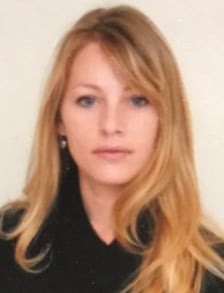
When not writing, Wright can generally be found talking about a book, painting something from a book, or tucked between headphones listening to a book. It’s kind of a theme. She loves reasonable heroines in unreasonable situations, noble—if brooding—heroes, slow burn and sweet kisses, a lot of havoc, and a little magic.
We talked with the author about reimagining a classic fairy tale through the eyes of a necromancer, why she's drawn to exploring dark topics like death and grief through humor and whimsy, and the romantic tropes she most enjoys writing.
How important is creative freedom to you, and how has indie publishing shaped your journey as an author?
It was everything. For me, the only fun in drafting was in having not a single rule or concern, just letting the story develop and the twists and turns take me where they might. I likely never would have made it this far if not for indie publishing, because I needed that freedom at the start of my career. I've grown tremendously since, and have learned a great deal about craft, but I still work best from a place of inspiration rather than obligation. Being responsible for all aspects of the process taught me so much, not only with the writing but the entire business, down to finding the right team when it comes to editors and designers.
Indie readers were incredibly supportive; I will always be grateful for the response to my early books. Their support gave me the courage to write whatever I am inspired to and to trust the process.
What first inspired you to write your newest release, A Necromancer’s Guide to Grave Mistakes?
I was discussing an idea I had for an entirely different Cinderella retelling, frustrated that the heroine's occupation felt a bit uninspired and brainstorming ways to make her plot more fun. My author friend, JA Andrews, offered up the suggestion of necromancer and we laughed and laughed at the ideas that spooled out, uncontrollably, from there. The image of a Cinderella digging up her mother to ask for advice, terrified of being caught in the act, really drove the narrative for me, but the undead animal companions appeared on page, and they quickly took over from there.
What draws you to approaching dark topics like necromancy through the lens of humor and whimsy?
I lived through some pretty dark traumas, none of them short-term, and found that I was very bad at sitting with difficult emotion. The only thing that kept me going during those times was an incredible support team and the reprieve of gallows humor. I feel so fortunate to have had both, as it was extraordinarily exhausting and sometimes there was little else to cling to besides helpless laughter. As a reader, I deeply love stories that approach difficult subjects in a way that not only doesn't hurt but offers an unexpected perspective.
-png.png?width=740&height=230&name=If%20you%20found%20this%20blog%20helpful%2c%20be%20sure%20to%20share%20with%20your%20friends%20and%20fellow%20book%20lovers!%20(1)-png.png)
You’ve written across many fantasy titles and series with immersive world-building. How do you go about crafting fantasy worlds in a way that’s imaginative yet grounded?
By reading everything I can get my hands on. I've never been an outliner--I write intuitively--and I feel like in order to succeed without concrete plans, one needs a solid understanding of story. For me, that means studying what works and what doesn't and really digging in to why my favorites are so satisfying. In addition to the mechanics of it, I find myself constantly inspired by story. One of the most satisfying things is seeing how another author pulled off something brilliant, and it clicks in my brain that a plot problem I've been struggling with can be approached from an entirely different angle. Reading widely and intentionally opens so many doors, creatively.
What’s your favorite genre to read? Do you gravitate toward content similar to what you write or something completely different?
I love Fantasy and Romantic Comedy best. I am an audiobook listener and whenever I write, the story plays out like a voice in my head—almost as if a narrator is dictating as I go—so I do have to be careful what I'm listening to in case it colors the voice of my work in progress. But I do love to read something with either a similar mood or style, or historical nonfiction that inspires details for the scene.
What are your favorite romance tropes to write, and what makes them the most exciting to explore? Are there any tropes you have yet to write that you’re dying to in the future?
I adore fake dating and forced proximity. Taking characters with conflicting goals or personalities and locking them into a shared project is immediate tension. I find it delicious to watch as they're pushed to the brink, then slowly realize they're the fool because they're accidentally falling in love. A favorite that I haven't written yet is pen pals—there's something incredibly satisfying about coming to love someone through letters, even if it's the opposite of the forced proximity I normally gravitate towards.
Romance isn’t dead… it’s just a little undead. Fall in love with Melissa’s newest release!
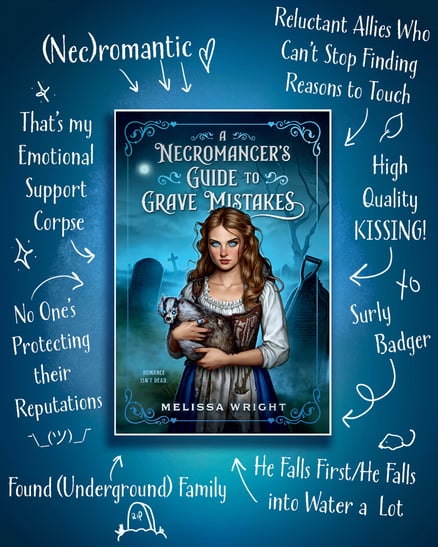
Any behind-the-scenes stories you can share about your creative process for A Necromancer’s Guide to Grave Mistakes?
This is not a sad book, but I absolutely hate to cry (not to mention it can be kind of embarrassing to catch myself tear-streaked over my own writing). Even so, through a pair of small undead mice skilled in mockery, I was definitely dancing near the cliff of some big emotions that I have personally, touching on some still-raw regrets, and so there was a lot of processing going on while writing this story. Interestingly, I think the most challenging bits for me to write ended up being the scenes that read as the funniest on page.
This is Book 1 of a new series called Grave Magic and Other Forms of Courtship. What can readers expect from future installments?
I had the most fun with side characters and animal companions with this one, and I loved putting characters in unexpected situations as clues to their mystery were revealed, so I'm focusing on keeping with those themes. The next title features a magical undertaker and a member of the palace guard, with inspiration from Snow White as the practical heroine is forced to endure both a handsome bodyguard and a murder plot.
How does your approach to romance differ between your Rivenwilde series and your newer book?
The Rivenwilde series was a bit of a love letter to Regency Romance. I greatly enjoy the wit of Regency and the tension created by propriety, and some of my favorites in the genre are absolute comedy. Rivenwilde let me inject those tropes and genre expectations with magic, and it was such a great playground. For A Necromancer's Guide to Grave Mistakes, Ella was removed from good society, so the character was able to throw the idea of maintaining her reputation out the window for a bit and run wild with improper behavior. I greatly enjoyed writing it, and I think giving the character that freedom allowed for a shift—suddenly it was the character's grief that made her more vulnerable instead of societal expectations.
What do you hope readers take away from your work?
I hope that they find joy in it. This series means a lot to me, but I am enjoying writing it more than maybe anything I've written before, and I hope that translates and they can share in the lightness it brought me.