
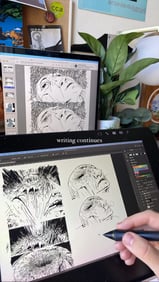
Nick Francis was born in San Francisco in 1994 and now lives in Oakland, California, with his partner & their three cats: Kiki, Noodle, and Blue. Working as a disabled illustrator and storyteller for: Fantastic Negrito’s Grammy Award-winning album The Last Days of Oakland and PBS & ITVS’ animated documentary BROTHER and for The NYU College of Nursing & The Monterey Jazz Festival. The Tumor in the Clay is his first graphic novel.
We spoke with the author about visual storytelling, the five-year process behind his debut graphic novel, and how surrealism can capture the lived experience of illness.
The Tumor in the Clay is almost entirely wordless. When did you realize this story didn't need any dialogue or narration, and is being restricted to visual storytelling limiting or freeing to you?
Much of my life has been spent failing to communicate symptoms: trying to use pain scales, is it burning? Is it throbbing? On a scale of 1-10, coming up with bizarre metaphors of burning meteors approaching the space behind my eyes, to tell doctors, nurses, teachers, friends, family what I was going through. At a certain point in your daily life, you stop trying, but creatively, the itch continues to gnaw at you. “With the right set or words then they will understand….”
A lot of my 2020 involved creative debates around narration—using it with animated projects that attempted to depict physical and mental pain and learning when to pull back, letting the images speak for themselves. It felt like the right time and place to challenge myself, my drawings, and my experiences with illness and grief to see if the right set of drawings could do what words failed to.
With The Tumor in The Clay finished and bound, that personal creative frustration has been satiated, but truly only the readers will be able to tell me if I have been successful. Have I made them feel something new?
Tell us about the process of creating your debut graphic novel! How long was the process, how different does the final product look than your first draft, were there any pages or sequences that changed dramatically during the process or took the longest to perfect?
The book took about five years—two to three years of drawing and redrawing, a year of coloring and editing, and then another year finding the right publishing partner to bring it to the world. The scope of The Tumor in The Clay has changed dramatically over time. It was originally penned as an 11-minute short film storyboard. The core of the story, the heart of it, has remained the same, but it has since bloomed out around the edges to become a full novel.
I worked with my uncle Andrew Lyndon, my unofficial editor, on The Tumor in The Clay. We spent the most time reworking the beginning and the ending of the story. I think in total we added an additional 40 pages, which was a fascinating experience because I’m so used to purely cutting down, down, down—but the book needed room to breathe.
Longest to perfect is difficult. It took a long time to get the surgeon’s face correct. Every great character has a distinguishing feature, something that immediately reads as HER, or in our case HIM. This is especially important when the character is fairly disfigured, that you can still recognize them in an instant. I had to go back and redraw the surgeon’s face more than anything else in the story.
The Tumor in the Clay is such an evocative title. Where did this title come from, and what does "clay" mean to you in the context of the story?
I always wanted the book to have a fairytale-esque title. The Something and The Something. Something charming to offset the gruesome nature of the drawings. The protagonist’s role in the story has always been that of a “Golem” to me, made into something artificial, incomplete, made of clay by his circumstances.
I recently reread A Wild Sheep Chase, and there is a line at the end of the book that I think gets to my idea of the surgeon when I began writing the book: “Weakness is something that rots in the body. Like gangrene. [...] something inside you that’s rotting away and you feel it all along.” Replace weakness with pain, illness. It feels like it's hollowing you out constantly. And you have to go about your day as best as you can, so you're hollow, yet you keep moving, absent-minded. Automated. A Golem. And how do you come back from that?
And well, he is riddled with strange tumors….
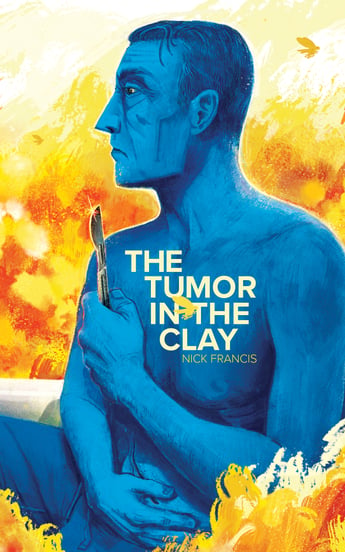
Immerse yourself in Nick's striking visual meditation on illness, grief, and transformation. Check out The Tumor in the Clay.
What made a surgeon the right protagonist for this story?
I had a lot of unused sketches of a character in a bathtub, rocking back and forth from the pain of his illness, the water dripping from the faucet ripping his ears, the light from the shaded window puncturing his eyes, dreaming of cutting himself open. So that version of the character—alone in the bathtub—has always existed. The question became how to make him competent enough, arrogant enough, to think that pure pain-riddled fantasy could actually be an achievable plan. A decorated surgeon was the answer.
How do you draw pain? Are there things you can communicate through posture, gesture, framing, or repetition that you don't think words could communicate as effectively?
There are infinite types of pain—physical, mental, emotional. If you’ve ever been in an ER, you know the litany of adjectives used to describe pain. And yet for so many words, phrases, and metaphors we have for pain, it's quite difficult in conversation to communicate. Drawings, paintings, and images benefit from their physical nature. You can describe a migraine as a stabbing pain, but everyone will draw the stabbing differently.
This is the inherent beauty of disability comics. In many ways, they can create an immediate sense of empathy in the reader with how sharply the drawings themselves communicate, cutting through our assumptions of how pain and illness function, of how we might presume someone’s pain feels, and instead get a closer understanding of that person’s unique experience.
You've worked in animation, illustration, music, and now graphic novels. How did your experience across other media play into your creation of this work? Did your experience with animation make it easier or harder to embrace the stillness of comics?
A lot of the methodology behind The Tumor in the Clay was centered on tension. Pushing and pulling the paneling, the line works, to tighten and breathe.
When you’re watching a film or listening to music, the director/animator/musician has more direct control over the audience. “Watch this shot linger,” or “Listen to this quick swell of notes.” Comics are, of course, a bit trickier because the reader has almost complete control; their eyes direct their own film. Written words help, but of course without dialogue or narration, the sense of timing in The Tumor in The Clay all comes down to paneling and the level of depth in the individual drawings. Nothing else to fall back on, everything is in the hands of the reader.
What do you love about being an indie author and working with Driftwood Press and IngramSpark?
Driftwood has been a phenomenal partner in getting The Tumor in The Clay to the masses. I really appreciate how hard the team works every day on this graphic novel and the full line up of incredible books they have on their plate. And everyone has been so kind and thoughtful!
We’ve been talking with local bookstores across the country and one of the things that really helps get The Tumor in The Clay on new shelves is Ingram. Bookstores already trust the quality of our debut book and are easily able to order The Tumor in The Clay for their customers if they have limited shelf space.
What can surrealism communicate about illness that realism can't?
Realism is always very literal. And humans sometimes have a difficult time hearing literal words and applying it to themselves. “Well you can’t always be in pain!” is something you hear a lot, because it's difficult to imagine if it's never happened to you.
Surrealism and the fantasy worlds allow us some distance from real physical pain. Where two people may struggle to comprehend each other’s specific illness, or painful lived experiences, or lack thereof, they may often find they can both understand each other based on a shared connection to a metaphor for illness, for adversity. There's something magical in how we can all see ourselves in stories, stories with curses and evil spells, metaphors rather than rigid concepts. A step removed helps the imagination.
It would be nice if the human species was able to more readily understand ideas like “masking”, if we had more fluid imaginations for other people’s experiences. Ones we ourselves have never had to experience, but we do seem to struggle with that more in real life than fiction.
Do you have a favorite frame or sequence in the graphic novel, and why?
I think the double page spread with the surgeon in the tub, staring in horror at the cicadas encircling him. I think that is my favorite. I do also love the early pages where the surgeon is preparing the bathroom and himself for the procedure. There is a “quiet before the storm” aspect to those pages that I've always really enjoyed.
Were there artists or filmmakers you kept returning to while making this?
When I’m working on a project like The Tumor in The Clay or another comic/storyboarding job, I try to limit the new media I consume during production. Instead, during the initial drawing phases, sketching, and outlining, I rewatch my old classics over and over again. For The Tumor in The Clay, there was a lot of Kurosawa, namely Ikiru and Dreams, Tsugumi Ohba & Takeshi Obata’s Bakuman, and a lot of concert footage and climbing documentaries (Monterey Pop with Otis Redding, Meru, Queen Maud Land, etc). While coloring, I started watching new media again, and my favorite films were Summit of the Gods and Drive My Car.
What do you most hope your audience takes away from this graphic novel?
I, of course, hope that people enjoy the work, that they enjoy the drawings—but, more than anything, I hope that The Tumor in The Clay can be part of a larger wave of comic fiction about illness and disability, from disabled artists & writers. That's the dream.