
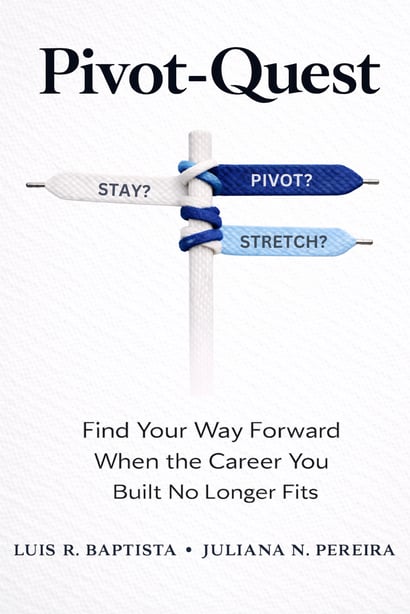
Drawing from their own multiple international career pivots and extensive research with successful career pivoters, Luis R. Baptista and Juliana N. Pereira present a structured, step-by-step framework for reinvention in Pivot Quest: Find Your Way Forward When the Career You Built No Longer Fits.

Luis R. Baptista has held more job titles than most people have hobbies. From Procter & Gamble and AT&T to leading Chicco in Venezuela, bringing Cinnabon to continental Europe, teaching at IE Business School, and reaching more than 140,000 learners on Coursera, his path has never followed a straight line. Across three continents and roles spanning engineering, marketing, product development, retail, and strategy, he was often told being a generalist was a weakness. It turned out to be his superpower: every pivot taught him how to learn fast, adapt faster, and connect dots others missed.
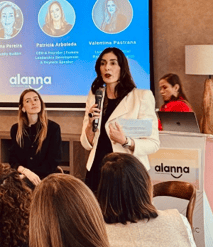
Juliana N. Pereira has spent her life crossing borders—between cultures, countries, careers, and communities. Raised between Colombian, Portuguese, and American worlds, she learned early that belonging isn’t something we find, but something we build. Her eight career pivots have taken her from advertising and product design to luxury fashion PR, from creating world-class retail experiences to founding and exiting a wellness venture, and from building community for more than 10,000 students at IE University to serving as Global CMO of an international technology consultancy.
Tell us about the creative process of writing this book in partnership. How did you decide to write it, and what was it like working together to conduct research and craft this narrative?
Juliana N. Pereira: When Luis first approached me with the idea of writing a book together, I don't think either of us imagined the journey we were about to begin. Looking back, I'm grateful that he saw something in me before I fully saw it in myself and invited me to be part of what would become Pivot-Quest. What made our partnership interesting is that we came at the same question from different perspectives. Luis brought a strong research and strategic lens. I brought eight career pivots of my own, years of building communities and advising organizations through transformation, and a deep curiosity about the human experience behind career change.
For me, the most meaningful part of the process was listening to people's stories. We spoke with professionals from more than 25 countries, across industries, generations, and cultures. Although every story was different, the emotions were remarkably similar. People weren't just changing jobs, they were questioning their identity, grieving old versions of themselves, searching for belonging, and trying to imagine what was possible next. That changed me as much as it shaped the book.
I started this journey thinking we were writing about careers. I finished it realizing we had written about something much more universal: what it means to navigate change with courage, curiosity, and hope. Perhaps my biggest contribution to Pivot-Quest wasn't simply my own eight pivots, it was helping ensure that every framework, every piece of research, and every idea remained grounded in real human stories. We wanted readers to feel that someone had walked this path before them, because that's exactly what our conversations around the world reminded us: nobody pivots alone.
After interviewing more than 100 career pivoters around the world, what surprised you most?
Luis R. Baptista: A pivot starts with exploration, and with recognizing that there isn’t one path. It’s a journey where you don’t know what’s next. The first step is always smaller than people think. It begins with listening to yourself and making sense of what you hear. It also means resisting the urge to label what happens to you as good or bad. The more useful move is to ask what this actually is, what it means, and what there is to learn from it. But the biggest surprise was this: exploring does not commit you to leaving.
We assumed everyone we interviewed wanted out. Many did not. Some explored and came back with more appreciation for what they had, more confidence, and a clear idea of how to grow where they were. In Chapter 15, Edge Experiments, we put it plainly: you are not signing up for the journey; you are just gathering information about whether this is even a path you want to take. Finding out something is not for you is as valuable as finding out it is.
Is there a case study that has stayed with you the longest, and what is it about it that resonated so strongly?
JNP: Without hesitation, Eileen's. When we interviewed her, she was 82 years old and had already reinvented herself 16 times. Think about that for a moment. Sixteen pivots over a lifetime. She completely changed the way I think about careers, ageing, and what it means to keep growing. One story she shared has stayed with me ever since. When she was young, her father gave her one piece of advice: "Learn how to type, and you'll never be without a job."
At the time, it was wonderful advice. Today, typewriters have disappeared. But what never became obsolete was the lesson behind it. It was never about typing. It was about learning.
Throughout her life, Eileen never stopped being curious. Every time the world changed, she changed with it. She learned new skills, embraced new opportunities, and never allowed herself to believe she was "too old" to begin again. That became her common thread.
Writing Pivot-Quest taught me that careers aren't built on a single skill. Skills will come and go. Industries will evolve. Technology will continue to reshape the way we work. But curiosity, adaptability, and a willingness to keep learning never go out of date. Whenever someone tells me they're too old to pivot, I think of Eileen. She taught me that reinvention has no age limit. The tools changed. Her curiosity didn't.
Thinking about a career pivot? Don't navigate it alone.
Learn from people who've made the journey and use a practical framework to turn uncertainty into your next step with Pivot-Quest!
What’s the career advice you most strongly disagree with today, and why?
LRB: Follow your passion. I believe that passion is a very broad term, and one may not distinguish between a passion that is supposed to be a hobby and one that could actually become your professional career. Our interviews showed us that the advice fails in both directions.
One woman we write about in Chapter 12 signed up for a voluntary sustainability program at her company. Most of her colleagues ignored it. She told us, “I was realizing that I was happier, more motivated, even giving more focus and time to those volunteering tasks than to my normal and standard role.” She was putting more of herself into unpaid work than into the job paying her bills. That is a passion by any definition. She did not follow it. She spent three years scouting it first, because she understood that liking the idea of sustainability is completely different from liking the work of sustainability. The fantasy shows you the summit photos. Reality is the actual climb.
Another man we write about in Chapter 15 started hosting literary tastings for friends. No business plan. No market research. For a year it was just a hobby, and he was careful not to turn it into a project. That's exactly why it grew into something. So the honest version is not follow your passion. Test it before you bet your mortgage on it, and leave it alone if it only wants to be a Saturday.
How do you know whether you’re facing temporary burnout versus a genuine signal that it’s time to pivot?
JNP: I don't think there's a single answer, but I often encourage people to ask themselves one question: "If everything around me stayed exactly the same except my level of rest, would I still want this career?" Burnout is often about depletion. A pivot is often about direction. Sometimes we simply need rest, boundaries, or a different manager. Other times we've outgrown the work itself. One of the patterns we noticed during our research is that many people confuse exhaustion with misalignment. The two can look very similar. That's why I encourage people not to make life-changing decisions at their lowest point. Instead, create space. Take a break if you can. Talk to people. Experiment. Notice what gives you energy rather than simply what drains it. Because your next chapter rarely begins with certainty. It usually begins with paying attention.
What do you think people are still misunderstanding about AI’s impact on careers? And what human skill do you believe will matter most in the age of AI?
LRB: Here is what people are still misunderstanding. They think this is a story about the future. It is not. It's already in the room.
We open the book with an engineer we call Marcus. His company’s entire data analytics department was let go, and he was told to absorb five years of their work in one month. He nearly quit. Instead, he gave the whole thing to AI and asked it to explain. It worked. Three months later, management reached the same conclusion he had, and let him go. Five people. A million dollars in annual salary. Replaced by a subscription that costs less than a Netflix account. His words: “You know that sooner or later you’re gonna get fired. It’s a question of when, not if.”
The second misunderstanding is that this is a fight. People are trying to slow it down, ban it, wait it out, or hope their industry is special. It isn’t a fight worth your time. The investment and the agendas behind this technology are larger than anything we have witnessed in history. Embrace it, prepare for it, put it into your daily life. Use it to plan the family holiday. Get it to explain your child’s maths homework to you. Write the letter to the tax office with it, or the speech for your friend’s wedding. The point is not the errand. It's the reps. The more ordinary hours you spend with it, the less it can surprise you at work.
In my humble opinion, adaptability, quick learning, and networking will matter most. We don’t know what we don’t know. But like being lost in a city, you can prepare yourself for whatever comes.
If there's one idea you hope readers remember years after finishing Pivot-Quest, what would it be?
JNP: I hope they remember that they are so much more than their job title. We spend so much of our lives introducing ourselves by what we do that it's easy to forget who we are beyond our work. Yet one of the most beautiful discoveries from writing Pivot-Quest was realizing that while our titles changed, something much deeper remained remarkably consistent. I call it our common thread. The common thread isn't what you've done. It's who you've always been.
If readers remember one thing years from now, I hope it's that reinvention isn't about becoming someone completely different. It's about having the courage to become more fully yourself. And perhaps one more thing. Nobody pivots alone. The conversations we have, the communities we build, and the people who believe in us often shape our futures far more than any five-year career plan ever could.
What would you tell another author who is considering self-publishing through IngramSpark?
LRB: I think IngramSpark has been an amazing partner. We had written a couple of articles on the Spanish version of HBR before, or research publications for foundations, but we had never ventured into a book. We reached out to more than 100 agents and publishers and received only one reply after 14 months. On the other hand, we met IngramSpark at this years’ London Book Fair, where we pitched our book, and conversations began right away. A deal was signed in less than 2 months. Since then, the support has been incredible.
The UK and U.S. teams made it possible, and for every idea we pitched, they found a way to make it real. A big thank you to all the wonderful people at IngramSpark who made this launch possible.
JNP: I'd tell them that writing the book is only the beginning. Publishing is really about building relationships; with readers, bookstores, librarians, reviewers, podcast hosts, communities, and people who believe in your message. One of the reasons we've appreciated working with IngramSpark is that they understand books don't simply need to be printed. They need to find their readers. As a first-time author, I've also learned that publishing asks you to become many things at once: writer, storyteller, marketer, speaker, entrepreneur, and community builder. That can feel overwhelming at times. But it's also incredibly rewarding because every conversation becomes an opportunity to connect your work with someone who genuinely needs it. My advice would simply be this: Write the book only you could write. Be patient with the process. Ask for help. Build your community long before launch day. And remember that success isn't measured only by the number of books you sell. Sometimes it's measured by one email from a reader saying, "I thought I was the only one." For me, that's what makes the journey worthwhile.