
Monster romance needs more than just a scary creature and a steamy love story. Readers want the emotional payoff of romance along with the danger, tension, fantasy, and otherworldly appeal that make the monster so compelling.
For first-time monster romance authors, finding that balance can be tricky. Make the monster too human and you risk losing what makes them interesting. Spend too much time on worldbuilding, and the romance can get buried. Lean too far into horror with your cover or metadata and you may attract the wrong readers.
Whether you’re writing your first monster romance or revisiting a draft, avoiding a few common mistakes can help you create a story that feels true to the genre and reaches the readers most likely to love it.
Here are eight common mistakes that can throw that balance off, and what authors can do instead.
Mistake #1: Making the Monster Too Human
Why it matters
When a monster becomes too human, the story can lose the very tension that makes monster romance appealing. Readers are drawn to the contrast between the familiar and the otherworldly, so if the monster starts to feel less distinct, the romance can lose some of what makes it so compelling.
The monster doesn't have to be frightening in every scene, but they should still feel set apart through their physical traits, instincts, customs, powers, or values. What matters most is not making the monster less monstrous, but making them more understandable. Readers should be able to connect with the monster's emotions, motivations, and vulnerability without feeling like they've simply become human in disguise.
When those differences still shape the relationship, the romance feels richer, the tension feels stronger, and the story delivers more of what readers came for.
Example
The Amphibian Man in the film, The Shape of Water
The Amphibian Man isn't just a romantic hero with scales. His physicality, the way he communicates, his instincts, and his connection to the water all remain essential to who he is.
-
- At the same time, the audience still understands his loneliness, fear, curiosity, and desire for connection.
- The film asks an intriguing question: What if someone who looks completely alien can still feel emotionally familiar?
Key takeaway for authors
Think about the difference between a monster who simply looks different and one who experiences the world in a different way. That second approach gives you more room to build romantic tension, conflict, and character growth.
Mistake #2: Spending Too Much Time on Worldbuilding
Why It Matters
When worldbuilding takes over, the romance can build momentum. Readers may appreciate the details of your world, but if too much information shows up way too early, it can pull attention away from the relationship at the heart of the story.
The strongest worldbuilding supports the romance instead of competing with it. Let readers discover the world through scenes, character choices, and emotional stakes, and save the extra details for the parts that truly shape the relationship.
Example
Twilight
Stephenie Meyer could have spent pages explaining vampire mythology. Instead, Bella learns about that world because she's falling for Edward. Much of the information is revealed through her growing connection to him, which keeps the relationship at the center of the story.-
- The world opens up as Bella's feelings deepen.
- The vampire details matter because they affect the relationship and the risks around it.
- Readers learn what they need when the story needs it, not all at once.
Key takeaway for authors
Give readers worldbuilding when it deepens the relationship, raises the stakes, or moves the story forward, not simply because the information exists.

Mistake #3: Forgetting That It's a Romance
Why It Matters
You can build a vivid world and create a fascinating creature, but if the relationship feels underdeveloped, readers will notice. In monster romance, the love story should feel believable, emotionally satisfying, and central to the story, with real attraction, growing tension, and enough vulnerability to show why the connection truly matters.
Conflict should add to the romance, not pull attention away from it. Obstacles and differences can create great tension and help the relationship grow, but the love story still needs to deliver the emotional payoff readers are hoping for. A compelling monster may catch a reader’s interest, but it’s the relationship that gives the story its heart.
Example
Edward Scissorhands, in the film of the same name
Here, the monster’s differences don’t fade into the background. They shape the romance itself.
-
-
Edward’s scissors affect how he touches others, which makes intimacy more complicated. They also influence how he shows affection and connects with his love interest.
- The relationship never asks readers to forget who he is; his identity stays central to the story.
-
Key Takeaway for Authors
A monster's defining traits should do more than make them interesting. They should shape the relationship in ways that deepen the romance, tension, and emotional stakes.
Mistake #4: Creating Inconsistent Monster Rules
Why It Matters
Readers are usually happy to go along with almost any supernatural premise as long as the rules stay consistent. If your monster’s abilities, limits, or behavior shift whenever the plot needs them to, the story can start to feel less believable.
That matters even more when those rules affect intimacy, trust, or vulnerability. The more clearly you establish what your monster can and can’t do, the more grounded and convincing the relationship will feel.
Example
X-Men Mutant Abilities
The X-Men franchise offers plenty of examples because each character has a different ability with different limitations.
-
- Rogue is a strong example here. Because physical touch allows her to absorb another person’s powers and memories, intimacy becomes emotionally and physically complicated. Her ability doesn’t just make her dangerous, it shapes trust, vulnerability, and connection, which is exactly why consistent monster rules matter.
Key Takeaway for Authors
If your monster has a supernatural trait that affects intimacy, let it shape attraction, fear, trust, and conflict throughout the story. Not just when it's convenient for the plot.
Mistake #5: Relying on Shock Value Instead of Emotional Payoff
Why It Matters
A monster may catch a reader's attention, but emotional connection is what keeps them invested. If a story leans too heavily on shock, intensity, or spectacle, those moments can lose their impact when readers don't feel connected to the relationship.
What gives monster romance its emotional weight isn't just how strange or dangerous the monster is, but why the relationship matters. Vulnerability, longing, trust, sacrifice, and connection are what makes the story memorable.
Example
Beauty and the Beast
-
- The Beast's final transformation matters because we've watched the relationship change throughout the story. What gives the moment its power is everything that comes before it.
- Belle sees his vulnerability, learns to trust him, and ultimately chooses him with full knowledge of who he is. By the time the transformation happens, the audience is already invested in the person beneath the monster.
Key Takeaway for Authors
Emotional payoff lands when the relationship drives the story, not just the monster's intensity.
Mistake #6: Treating YA and Adult Like the Same Audience
Why It Matters
Your genre positioning should be intentional from the start. In monster romance, YA versus adult isn't just about character age. It also shapes themes, characterization, sexual content, and reader expectations.
If your story, cover, description, and category send mixed signals, readers may come in expecting one kind of experience and leave disappointed. There can absolutely be overlap, but the key is knowing your audience and shaping the book with that audience in mind.
Example
Rebecca Yarros' Fourth Wing
-
- Fourth Wing is a strong example of how a book can have many YA-coded elements while still being positioned for an adult audience. It features a young protagonist, an academy setting, dragons, coming-of-age themes, and strong friendship dynamics, but its marketing and content place it firmly in adult fantasy/romantasy.
- Age alone doesn't determine category. A 19- or 20-year old protagonist doesn't automatically make a book YA. When readers misread a book's intended audience, even a strong story can end up with disappointed reviews simply because it didn't deliver the experience they expected.
Key Takeaway for Authors
Your reader should know who your book is for before they buy it, not have to figure it out afterward.
Mistake #7: Designing a Cover That Looks Too Much Like Horror
Why It Matters
Your cover should help readers understand what kind of monster story they're getting. In monster romance, those first visual signals matter. If a cover leans too heavily into blood, terror, or violence, readers may assume the book is horror rather than romance.
A strong monster romance suggests both the creature or fantasy element and the romantic promise of the story. That balance can come through in color, typography, posing, symbolism, or overall mood.
Examples
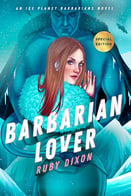
Barbarian Lover by Ruby Dixon
This is a strong example of a monster or alien romance cover that doesn't try to look like horror or sci-fi first. The attractive blue alien, romantic composition, and overall design make it clear that the book is a romance.
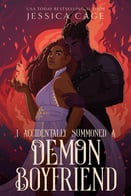
I Accidentally Summoned a Demon Boyfriend by Jessica Cage
This cover feels playful and sensual rather than frightening, signaling an adult romantic fantasy with an unusual creature rather than a horror story.
Key Takeaway for Authors
Strong monster romance covers signal the romance first, then use creature or fantasy elements to hint at the subgenre. Your cover doesn't need to show exactly what the monster looks like—it just needs to give readers a clear sense of the experience inside.
8. Treating Metadata as an Afterthought
If your categories, keywords, and descriptors are too broad or misleading, your monster romance can get lost or end up in the hands of the wrong readers. Strong metadata helps readers quickly understand what kind of story they're looking at and whether it's a good fit for them.
That starts with choosing the right genre, category, keywords, and tropes. Use terms readers actually search for, and make sure your descriptors reflect the book you've written. Don't forget to choose your Thema codes, which are a powerful way to make your book more discoverable in the Global Market.
Good metadata isn't about stuffing in buzzwords. It's about presenting your monster romance clearly, honestly, and in a way that helps the right readers find it.
Example
Using Jessica Cage's above book as an example, this chart shows what weak metadata looks like as opposed to good metadata.
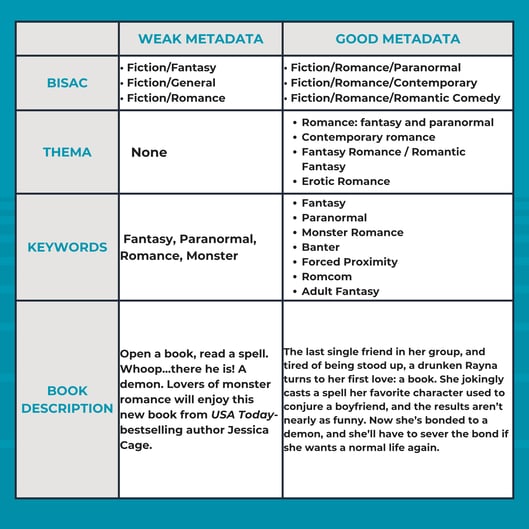
Strong metadata helps put your book in front of readers who are already looking for exactly that kind of story, while weak metadata can limit your audience to people who already know your book exists.
It’s also worth remembering that metadata isn’t something you set once and forget. Keywords can change as your series grows and as reader language evolves. After all, hardly anyone was searching for “romantasy” a few years ago. Good metadata is one of the most useful sales and marketing tools you have, so it’s worth revisiting and keeping current.
Final Thoughts
Monster romance has two promises to deliver: the monster and the romance.
The best books don't sacrifice one for the other. They use the monster element to create tension, vulnerability, conflict, fantasy, and attraction—while still delivering the emotional experience romance readers expect.