

Does the information you include with your book really matter?
In short, yes, it can. But let’s dive deeper into this question and explain what we mean by book information, aka “Metadata” and how it could directly affect book discovery and sales.
Metadata is a term used by the book industry that refers to all the information about your book. The title name, the author’s name, the size of the book, the format, etc. Because there are a lot of different types of books being published in the world (academic textbooks, romance novels, instructional manuals, children’s picture books, etc.) there is a lot of information needed to help the market know what category your book fits into. Specific types of metadata convey this and help your book reach potential readers and customers that are looking for this type of content.
Book descriptions, keywords, BISAC subjects, and Thema subjects are some examples of metadata fields that help retailers, libraries, and consumers understand what your book is about and whether they want to purchase it. This information is used by online retailers as well as brick and mortar stores to help properly categorize and merchandise books. Different fields are used in different ways, but they all work together behind the scenes to help get your book into the hands of people searching for it.
Here is a side-by-side example of a book with minimal discoverability metadata as compared to more descriptive, rich metadata.
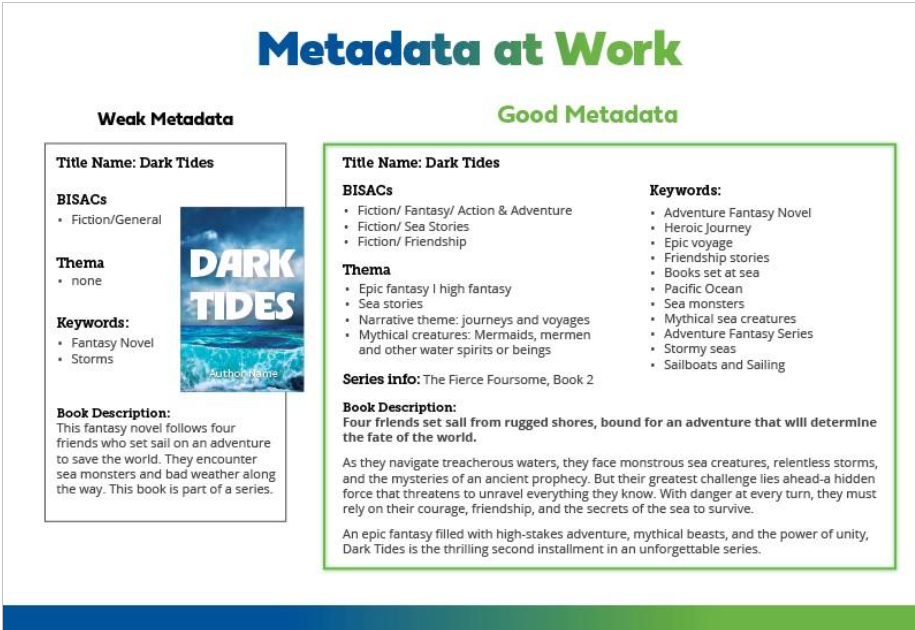
The good metadata example gives a much clearer picture of what this book is about. This information significantly increases the chances of this title being discovered when someone in the market is searching for an ocean-themed fantasy adventure book.
Increase discoverability by learning how to best optimize your book's metadata with IngramSpark's FREE Metadata for Books course.
Metadata in Relation to Sales Performance
To further measure the impact that good metadata can have on a title’s success, we developed a case study to monitor sales on two sets of similar titles. 2,000 titles were identified based on the criteria below.
• Print books published between 2019 – 2021
• Priced in USD and available in Ingram’s distribution network
• Previously sold between 24-120 units in last 12 months (at the time the titles were identified)
• Had two or less BISAC subjects in the metadata
After the titles were identified, they were divided into two comparable groups with a similar genre distribution. One group of titles underwent a thorough review to identify metadata improvement opportunities. The metadata for these titles was then updated and optimized based on industry best practice.
• Three very specific BISAC subjects
• Specific Thema subjects and qualifiers
• At least 10 keywords and key phrases
• Regional subjects when applicable
One group now had specific, robust metadata (Group A), and the other group (Group B) retained its existing base-level metadata. Once the enhanced metadata for Group A was distributed to the market and reflected across retail and discovery channels, sales performance for both groups of titles was tracked over time.
Positive Outcomes
The results showed a clear and consistent advantage for the improved titles, with Group A achieving an average sales increase of 9% compared to Group B over the course of a year.
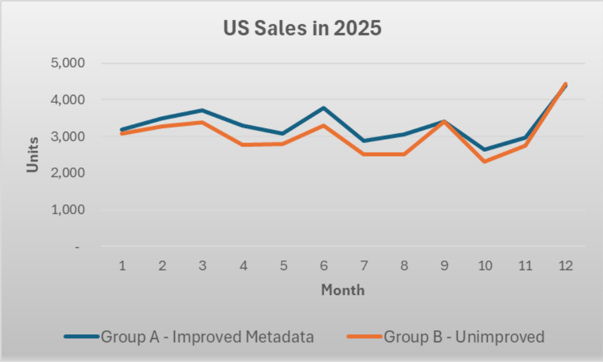
This sales increase was not limited to isolated periods. The improved titles outperformed the unimproved titles 41 out of 52 weeks throughout the year, and 11 out of 12 months. This demonstrates that the impact of optimized metadata was both sustained and reliable.
International Impact
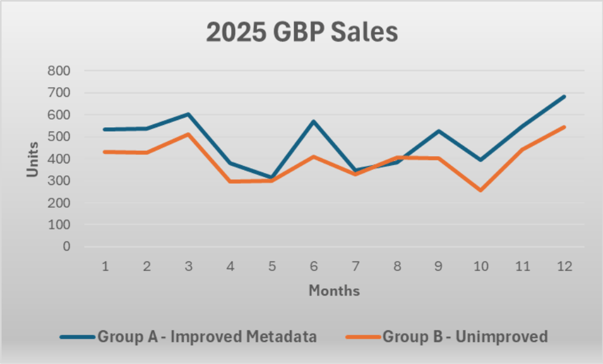
In addition to monitoring U.S. sales, we extended the analysis to include these same two title groups within the UK market to assess whether the impact translated internationally. The results were even more pronounced. Titles that received metadata improvements experienced an average uplift of 22%, more than doubling the gains observed in the U.S.
This stronger performance in the UK suggests optimized metadata that includes Thema subjects plays an especially critical role in international discoverability. The findings reinforce that metadata enhancements not only scale across markets but may deliver outsized returns in regions where discoverability barriers are higher and competition for visibility is more compressed.
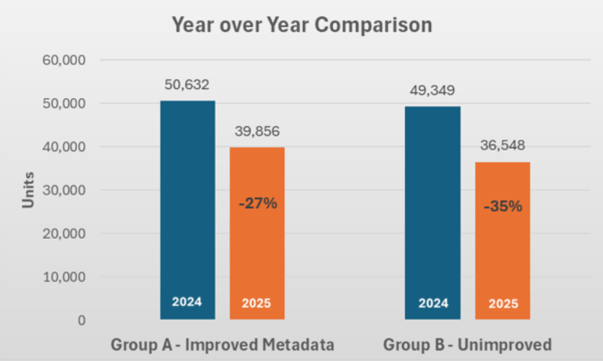
Slowing the Decline
Titles in Group A also improved their year-over-year performance in U.S. sales. The titles in this case study were all 3 to 5 years old. While sales of older (backlist) titles naturally decline over time, the titles that were improved declined much less. Specifically, their sales dropped 8% less than the unimproved title group in 2025 as compared to 2024.
Conclusion
This case study demonstrates that metadata is not just supplementary information, but a critical driver of book discovery and sales when applied strategically. Titles enhanced with specific BISAC and Thema subjects, robust keywords, and best-practice optimization consistently outperformed comparable titles with less detailed metadata.
Overall, the findings confirm that investing in high-quality, descriptive metadata can directly contribute to improved market visibility, broader international reach, and long-term sales resilience. To learn more about discoverability metadata and how you can optimize your titles, see our free metadata guide or contact your LS representative today.
*Based on a case study conducted in 2025 looking at sales on comparable titles with quality metadata vs basic metadata. Similar results are not guaranteed.