It's so important for publishers to meet their audience where they are. With their soaring popularity, offering an audiobook format for your title is more critical than ever, whether you’re an indie publisher or one of the big five. While hiring a professional narrator is the most common path, author narration is an attractive option as well.
When considering author narration, it’s important to do a quick cost/benefit analysis. Will there be some sales boost from having the narrator read their own words? For memoirs, personal growth, and business titles, author narration can add to the authenticity of an audiobook. Authors with large followings and a known speaking voice may also see a tangible increase in sales by narrating their audiobook.
But what is the cost of author narration? Assuming the production happens smoothly and competently, there's no downside to author narration beyond the time commitment required for the author to record. However, producing and narrating an audiobook is a technical and nuanced process, and there are many pitfalls that can set back or even ruin a production.
On the most basic level, there are three things you need to focus on to achieve good audio quality:
- Equipment
- Space
- Vocal Technique
Equipment
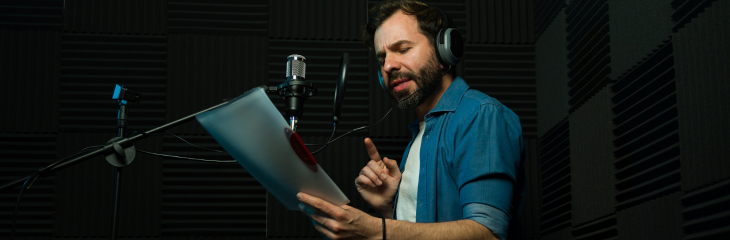
To start, you’ll need high quality audio equipment, namely a microphone, wired headphones, and a boom arm. The microphone should probably be a dynamic microphone with an interface, though a high-quality USB mic can work. Wired headphones will allow you to monitor your voice and any background sounds while speaking. This is a critical part of the production process, and unfortunately, Bluetooth headphones will create an audio delay, making the monitoring process impossible. Finally, the boom arm will allow proper placement of the microphone, helping to ensure consistency of sound throughout the recording.
Space
The recording space is another important, and sometimes overlooked, aspect of recording. The room must be quiet, meaning no traffic noises, nature sounds, air conditioners, or computer fans humming in the background. Beyond a merely quiet room, it must also be acoustically neutral, meaning that any audio reflections (echoes) are broken up and minimized. Flat hard surfaces reflect sound very well, so those surfaces should be minimized in a recording space. Instead, you want to increase the presence of sound absorbing materials, like foam, thick cloth and carpet, and sound diffusing materials like bookshelves and furniture.
Vocal Technique
Vocal technique is the third important factor of quality audio production. It’s important to have a consistent vocal sound throughout the audiobook and to avoid noticeable changes from session to session. Speaking at length can be difficult and inflict fatigue and strain on an inexperienced narrator’s vocal cords. The best author narrators are those that have significant public speaking experience, specifically speaking for long periods of time, 30 minutes to 2 hours.
It’s possible to record in shorter sessions to help with this, but that isn’t ideal from a production or scheduling standpoint. Beyond preempting vocal fatigue, a narrator must perform the text in a clear way, avoiding mumbling, awkward phrasing, incorrect pronunciation, and excessive mouth noises (saliva smacks and pops that you would never be aware of until you hear yourself on a good microphone), while also tonally matching the content of the book. Professional narrators are practiced in this art form, and while some amateurs can and do excel, it can also turn into a maddeningly long and involved process.
In addition to making sure the audio you’re capturing is up to snuff, the actual capturing of that audio takes a basic understanding of audio software. Garageband for Mac and Audacity for either Mac or PC are both fairly accessible and inexpensive audio programs capable of recording audiobooks. Regardless of what program you decide to use, you'll probably need to dedicate a few hours to watching tutorials and getting comfortable with the software, specifically making sure your inputs and outputs are correct, you can properly record and edit files, and you can save and export files and sessions.
Regardless of whether you opt for professional or author narration, it’s always a good idea to hire a professional production house to manage and guide the process. A good production house will help you navigate the technical hurdles and offer feedback, advice, and hands-on expertise to make sure the final product meets or exceeds the professional standard for audiobooks. Poorly produced audiobooks can be a massive waste of time and money—they don’t sell as well and can alienate your audience. By contrast, a professionally produced audiobook can expand your audience and increase your profile as an author and/or publisher.
If you have the inclination and the time to dedicate to a production which can last several weeks to several months, then author-narration can be a fine choice for an audiobook. It’s less straightforward and can end up being more costly than simply hiring a professional narrator, but it can also be a practical and rewarding endeavor.