

T.W. Larsen's debut novel, The Emperor’s Children, is a tragic fantasy where monsters and magic meet morally complex challenges and grounded human moments.

Larsen loves fantasy that has its feet in the dirt; stories full of grief, grace, and the smallest moments people often forget. Off the page, he works as a Crisis Intervention Trainer, teaching de-escalation and communication skills through immersive performance. Larsen lives in Colorado with his partner and cat, where the mountains and monsters coexist peacefully.
We spoke with the author about his nine-year journey to publishing this book, why he's drawn to "tragic fantasy," and what attracted him to indie publishing.
You have a video on your Instagram that shows all of your drafts, world-building, and revisions over the course of 9 years ideating and working on this book. How much did elements of your novel change from initial drafts to final manuscript? What part of that journey felt the most challenging and the most enjoyable?
The book changed a lot over its life course, as I think all creative endeavors do. When I started, Ada'Kar was little more than a thought exercise in world-building, and the idea for The Emperor's Children didn't come until over three years later. That first draft was, well, I liked it. But it was far from being polished. I had never written anything of that length before, so it took many years of revision and support from my mentors to hone my voice within the prose. While much of the plot and pacing of the first draft survived all the way to the final (minus a few darlings lost along the way), the greatest change came in the language. I love lyrical prose, and finding the balance between brevity and beauty became the most challenging, and rewarding, part of the editing experience.
What advice can you offer to other indie fantasy authors who are in the throes of their own lengthy creative process for a novel?
First, find someone you trust to be honest with you. Then trust yourself to stand your ground. Writing is a solitary act, but storytelling isn't.
We spend months, years, perhaps decades, living with our stories inside our heads, and we can become so close to them that we lose perspective. Having a mentor, or a friend who can read your work and truthfully tell you what is and isn't working, is the greatest gift.
I'm not going to lie, receiving critique isn't easy. Especially when it comes to something we love. But some of my greatest growth as a writer has come when I was told flat out that an entire hundred pages of my book needed to be torn down and redone. It hurts, and it's scary, but it's so, so worth it. And it's only in the receiving of critique that we discover what really matters to us—the parts you know you need to keep, no matter what anyone says.
Where did the initial idea for this book and the fantasy world come from?
Well, the world itself started as a bit of a thought experiment. I've always been a huge D&D and fantasy fan, but I craved a setting with more verisimilitude. So, I set to work on Ada'Kar, mostly as a way to explore what a fantasy world built from the ground up might look like: starting with cosmology, orbital mechanics, and a magic system that felt more scientific than mystical. I wanted a setting that "forgot" it was fantasy and blended my favorite elements of the genre with my love for physics.
Then, after a few years of building and tinkering and testing the world at my own D&D table, I realized it was growing beyond even that. Cultures and languages and histories started filling in the corners of my map, and that's when the idea for the book came. Much like my approach to world-building, I wanted a story that could "forget it was fantasy.” I love this genre, but so often it feels defined by epic quests or looming evil, and I wanted something smaller. Something that felt human, even within a world of magic and monsters. Thus, The Emperor's Children was born.

You classify this book under the subgenre of “tragic fantasy.” What draws you to that style, and why do you think it resonates so much with audiences today?
I think tragedy is a beautiful genre that often gets unfairly correlated with "dark" or "sad" stories. For me, tragedy is a language of hope. It asks us to seek out the light amidst the darkness, right up to the very moment we can't. And I think in today's worsening world, that's a sentiment readers are finding solace in. It's becoming harder to accept the good vs. evil story we've heard so many times, and the idea of an inevitable triumph over darkness no longer feels congruent with the world we live in. People are awakening to the fact that “saving the world” isn't just a simple matter of valor that can be accomplished by some hero, but is instead a painful, costly sacrifice that must be borne day in and day out without reward. That “true good” is, in fact, thankless, and tragedy reflects that.
We've of course seen a rise of dark fantasy nowadays, spanning everything from romance to epic, but I think tragedy remains distinct. It's not defined by its bleak atmosphere or grisly themes, but rather by catharsis. By its willingness to walk hand in hand with its audience into grief and anger and loss, and then trust the reader to sit in those emotions. It's not about the happy ending, but rather the journey that takes us to the end.
Does your work have the same “epic” focus and scale as other fantasy novels?
Ada'Kar is, in its bones, a classic high-fantasy world, with sprawling cultures, histories, and monsters. But that's just the setting. I wanted the stories I tell to feel more human. Even set in a fantasy world, we can all relate a lot more to an uncomfortable moment of vulnerability than we can a sword fight (even though sword fights are objectively very fun to write). And it was that want for a closer, more honest look into the characters which kept The Emperor's Children from becoming truly “epic.”
Sure, it has its monsters and magic (and yes, a sword fight), but its real focus is on the little things: on the simplicity of hushed words shared between bites of bread, or the bittersweetness of sitting in a beautiful place for the last time. It might have an epic setting, but this story remains grounded in a way that, I hope, will resonate with readers of fantasy and literary fiction alike.
Immerse yourself in the dark fantasy world of Ada’Kar with T.W.’s debut novel
How does a social justice dynamic come into play in The Emperor’s Children? And is there a message you hope readers take away from your work in that vein?
Social justice is central to The Emperor's Children, from its larger political themes of systemic inequality and racial injustice, down to its smaller meditations on power and responsibility. While the book engages directly with issues like cultural erasure and how biases infect even our most personal relationships, at its core, this story is about the deep, unending cost of the greater good. I wanted to look at the idea that just wanting to be a good person wasn't enough when you're fighting an unjust system, and that even the most staunch allies of change can be blinded by their own privilege.
What attracted you to indie publishing, and what has been the most rewarding part of your experience as an indie author?
I was drawn towards the idea of indie publishing first out of a sense of protection and care. This story and this world have been my main creative endeavor for almost a decade now, and it was really important to me that I have a hand to play in every step of its coming to life. From the editing, to the design, to how I share it with the world, I wanted this work to feel like me, and I didn't want to risk diluting that. Now, I will say, I may have severely underestimated just how much work it is to do everything yourself, but in the end, I feel it was more than worth it.
Watching something take such slow, careful shape is unlike anything else I've experienced, and holding my first printed copy after so many years was enough to move me to tears, because it truly felt mine.
You also work as an actor and an activist! Tell us about these facets of your life and how they inform your storytelling in other forms. How did those experiences affect how you wrote this book?
Yes! Outside the writing world, I work as a Crisis Intervention Trainer, teaching de-escalation and communication skills to social workers and law enforcement through immersive role-play. Which is a lot of words to say that, as an actor, I scream, cry, and berate people in order to get them comfortable handling people in crisis. Whether it’s helping someone through the throes of grief or the depths of psychosis, the team I work with mentors officers on how to bring kindness and empathy back into policing. Two skills we have allowed to go woefully undernourished as a nation. I got into the work because I'm a firm believer in creating positive change wherever you can, and while I might not have the power to bring about large-scale police reform, or widen national mental-health access, this was a way for me to make an impact, even on an individual scale.
And this work has seeped into my writing in more ways than one. I've been working in the world of CIT for over a decade now, and the one lesson I have seen learned again and again is that the strongest moment between two people is never an act of authority, but one of quiet kindness. In our hearts, I think we all crave the chance to be seen, and when our emotions have brought us to the tipping point, and the whole world feels like it's burning down, it can be the simplest things that bring us back from that ledge. A small kindness. An understanding. And everything feels a little easier. It's one of the reasons my writing prefers to focus on the small moments, because I think they are far more powerful than we often give credit for.
What draws you to writing this genre of book? Do you have a favorite storyteller or world-builder of all time?
As I said earlier, I've always been a huge fantasy fan. While it feels cliché to cite Tolkien as an inspiration, I'd be lying if I didn't. I first read The Lord of the Rings when I was 8, then Dune when I was 12, and since then I've had a very skewed idea of how much genealogy and world-building is appropriate for the genre. But that world-building is what draws me to fantasy and sci-fi.
To me, world-building feels like a beautiful medley of science and art, whether it’s the construction of a city and its politics, or the fleshing out of imagined ecosystems and magical structures.
Worldbuilding is an invitation to learn about anything; after all, there's nothing more enjoyable than spending a week studying orbital mechanics just so you can make sure your moons don't fall out of the sky.
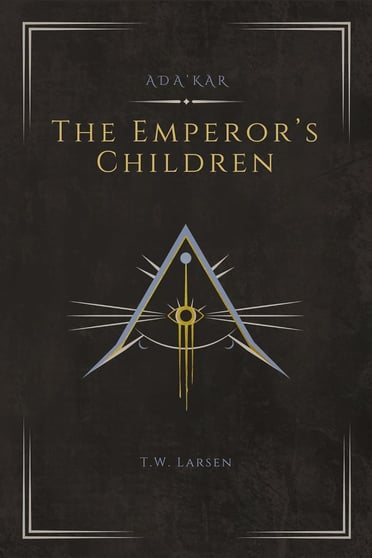
Tell us about the origin of your cover design and what it represents.
Well, I can't tell you everything (that would be a spoiler!), but the symbol itself is based on Ada'Kar's planar map, a geometric design meant to visualize the structure of existence, and the basis for Ada'Kar's magic system. The design was actually one of the first things I created for Ada'Kar, as I tried to wrap my head around a multi-dimensional magic system based (loosely) off of string theory. As for the eye in the center...that you'll have to read for.
What’s next for you in terms of writing projects and continuing to tell stories within this universe?
I have two more stories on the docket! One is a direct continuation of the events laid out in The Emperor's Children, and the other is a separate fantasy-reimagining of one of my favorite women in history, Agrippina the Elder. But as for the world of Ada'Kar, I have no intention of giving her up. I've been working within this world for 9 years, and I would be beyond happy if I got to do it for another 90. There will be many more Ada'Kar novels to come.