

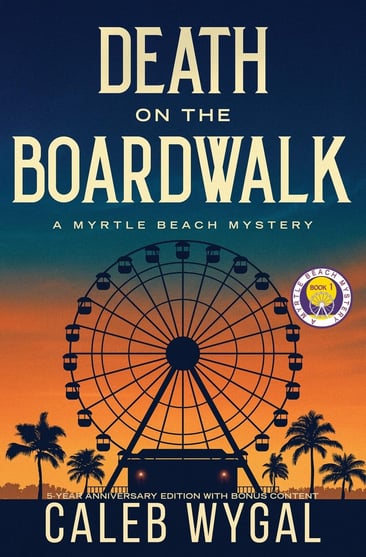
Caleb Wygal is the author of 13 novels, including the award-winning and critically acclaimed Death on the Boardwalk, Book 1 of the Myrtle Beach Mystery Series, which received accolades from Women’s World Magazine and won the Pinnacle Award for best Mystery (2021).
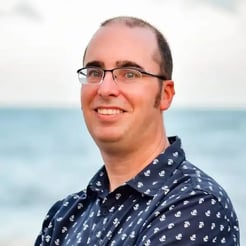
The fourth book in his Myrtle Beach Mystery Series, Death on the Causeway, was the Readers' Favorite Gold-Medal Winner for Best Amateur Sleuth Mystery (2023). A member of the International Thriller Writers and Mystery Writers of America, Wygal's had the privilege of being a Mystery Writing Instructor with the Osher Lifelong Learning Institution at Coastal Carolina University. He is currently at work on the next book in the Myrtle Beach Mystery Series and lives in Myrtle Beach with his wife and son.
What first inspired you to start the Myrtle Beach Mysteries series?
When my family moved to Myrtle Beach in January 2019, my main job was as a stay-at-home dad to our son. I wrote as a hobby and performed social media marketing for small businesses. Our son was at an age where he wanted to stop taking naps in his crib, so I'd put him in his carseat with his favorite blue blanket and stuffed animal, put on some classical music, and drive up and down Ocean Boulevard so he could get his sleep. It was during these trips that I formulated the idea for the series. I used my knowledge of Facebook marketing to do some research on the idea of cozy mysteries set in Myrtle Beach. Facebook/Meta used Interest Targeting at the time to serve ads to users. I looked for people interested in Cozy Mysteries and Myrtle Beach, and learned that an audience of around 47 million users might be interested. The first book in the series, Death on the Boardwalk, was born just over two years after we moved to Myrtle Beach.
You’ve been writing this series since 2021, and you just released a special Five-Year Anniversary edition of the first installment, Death on the Boardwalk! Did revisiting this book with bonus content spark any reflections about the series as a whole and how it has evolved since you wrote Book 1?
Yes. It certainly did. We've actually been reading these books to our son as bedtime stories, going through the entire series. It's enlightening to see how my writing style and storytelling ability has evolved in the past five years.
Fan of cozy mysteries, amateur sleuthing, and small-town drama?
Check out Caleb's full Myrtle Beach Mystery series here!
How do you continue generating new and fresh story ideas within the same universe, and what usually sparks the beginning of a new novel for you - a character, a theme, a setting, or a twist?
Myrtle Beach has no shortage of inspiration. I get so many ideas that I jot them down in a notetaking app on my phone and look through them when I start looking ahead to the next book I'm going to write, usually well before my current WIP is finished. (I have two complete outlines for future books right now) What happens first is I come up with the victim. Who gets killed and why would someone want to murder them? Then I figure out how the murder happened to create a puzzle for the sleuths to unravel. From there, I figure out the opening and closing scenes of the book and fill it in from there.
While I do work from an outline, I enjoy discovering how to surprise readers along the way. It's like a paleontologist seeing a bone sticking out of the ground. He might have an idea what type of dinosaur the bone belongs to, but by the time he's finished excavating, it's something completely different.
What draws you to writing mysteries over other genres? Do you also gravitate towards mystery as a reader or something completely different?
As I mentioned in the previous question, I love the puzzles involved, both as a writer and a reader. I love reading mysteries, but not as much as I enjoy creating and solving mysteries from behind a keyboard.
How would you define the difference between a “cozy mystery” vs. a more traditional thriller? And why do you think these types of small town, amateur sleuth stories resonate so much with your readers?
Cozies typically take place in small towns where it's easier for the reader (and author) to keep track of characters over the course of a single book or series. You'll often find more interpersonal stories in the small-town mysteries, where traditional thrillers often involve high stakes themes that could affect not just the protagonist, but many others, if the bad guy wins. I believe my target demographic enjoys the not quite so huge ideas involved in commercial thrillers but get absorbed in family drama or lifestyle related mysteries.

When you sit down to write a new book, how much of the plot and twist are pre-planned, and how much do you let the writing and characters lead you? Do you have a favorite twist in your own work or in another mystery you love?
I usually have a few plot twists planned out ahead of time, but I'm not afraid to deviate from the outline if a better, more surprising, idea strikes me while writing. My favorite plot twist was completely unplanned. In Death on the Golden Mile, I wrote it with one killer in mind. Then, about two-thirds of the way through writing the book, I got to the scene where they were going to arrest the person, but I thought: what if this certain person did it instead, and murdered the suspected killer before he could talk? It surprised me and went on to surprise readers as well.
What are you working on now, and can you tease anything about your next project?
I'm almost finished with the first draft of Book 10 of the Myrtle Beach Mystery Series, titled Coastal Vendetta. After that, I'm going to complete the first book in a new mystery series set in Myrtle Beach about a recently divorced single dad surf shop owner and a mysterious woman who is a chef and former spy at the restaurant next door. Except, she was involved in a car accident in Europe (like I did) months before the restaurant opened and can't remember who she is but still knows how to cook through muscle memory. When they discover the body of her sous chef in a dumpster behind their businesses on the day of the restaurant's grand opening, the surf shop owner ends up helping the spy/chef unravel what happened. That will be titled The Newcomer. I spent a year researching these characters before I ever wrote the first word of the book.
If you could give aspiring indie authors a piece of advice, what would it be?
Decide if your book is a passion project, or one you want to make money with. If you have a fantastic idea for a book, that's one thing. You might think it would be great, but the question you have to ask is: who will read it? Many struggling authors I speak to believe their book is the next great American Novel but fail to see that their audience is limited on who will buy it. Don't delude yourself into thinking that just because you write it, readers will come.
Have a strategy of how you're going to sell this book to readers before you write and know who you're writing to.
Most importantly, write every day. Ten words. A thousand words. It doesn't matter. The book won't get done if you don't write, and you won't get better as a writer for the same reason.
How did you first get into writing books, and how has indie publishing shaped your success?
I began writing out of boredom while working for my uncle at his hearing aid business in Greenville, South Carolina, during the early 2000s. I was in a car accident right out of high school and suffered a severe brain injury. I had to relearn how to walk, talk, and write my own name. The doctors said I'd never be able to work a full-time job unless it was something that didn't involve a lot of stress, like a desk job in a quiet office. Needing something to do (because my uncle told me I couldn't read books), I started writing short stories. Over the course of a year, those short stories turned into my first book, Moment of Impact.
Indie publishing has allowed me to have the freedom to write and publish books when I want to, and it's given me the freedom to explore various means of marketing, both online and boots on the ground, to find readers. That's allowed me to eventually start a publishing company with three of my great author friends, Green Ferns Publishing House. I use the processes I've learned to help others publish their books who otherwise couldn't.
Tell us about Green Ferns Publishing House! How did this venture begin, and how has your experience been so far supporting other authors through their publishing journey?
Over the course of the past five years, I've met many new and established authors in the Myrtle Beach community. They see what I've done to make writing my full-time job and individually suggested starting a publishing company. Last year, I pulled together three amazing women who have their own strengths. Lisa Borne-Graves is an editor-extraordinaire who is an English lecturer for Coastal Carolina University, Maegwen Salley-Massie is a talented fantasy writer possessing a keen business savvy, and Kelly Capriotti-Burton is one of the most creative people I've ever met and also owns the top running shoe store in the Grand Strand, Black Dog Running. Over several meetings at a brewery, Green Ferns Publishing House was born to give voice to authors who have stories set in the South to tell. I love hearing success stories from authors who I've helped along the way.