

Defying all odds is what #1 New York Times- and international bestselling author Sherrilyn Kenyon does best. Her new paranormal urban fantasy series, Infernal Affairs, kicks off with Hell to Pay. Lucifer’s exiled son becomes a reluctant supernatural cop on Earth, framed for murder and racing to clear his name before he’s dragged back to Hell.
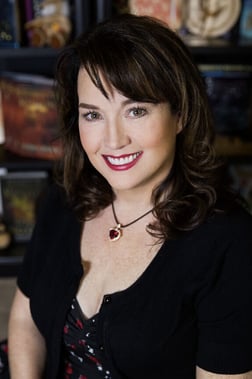
Since her first book debuted while she was still in college, Kenyon's placed more than 80 novels on the New York Times list in all formats and genres, including manga and graphic novels, and has more than 70 million books in print worldwide. A pioneer in paranormal, fantasy, science fiction, and romantasy, she has become one of the most popular and influential authors in the world (in adult, YA, and middle grade fiction), with dedicated legions of fans known as Paladins, thousands of whom proudly sport tattoos from her numerous genre-defying series.
We talked with the author about the inspiration behind her new novel, how the universes in her books intersect, and the one story she says saved her life.
You’ve built a massive career across traditional and indie publishing. What creative freedoms have you gained in indie publishing that changed how you approach storytelling?
The biggest benefit to me is that I don’t have to wait a year (or more) to have a release date. I also have the final say when dealing with an editor. In trad, the editor often has the ability to completely rewrite a book and make whatever changes they want, even if the changes are wrong. In indie, those changes are totally up to the author. Best of all, I don’t lose my rights to my worlds or characters.
Best of all, [in indie] I don't lose my rights to my worlds or characters.
What first inspired you to start writing, and how has your creative process evolved over the years?
I started drawing “novels” before I could write. I don’t know why, but writing is all I ever wanted to do. In my kindergarten Brownie manual it says: “When I grow up, I want to be a writer and a mother.” As for how it’s changed, I no longer write with crayons. Seriously though, the only thing that’s changed are the tools I use. The process itself hasn’t really changed at all.
Many of your heroes are exiles or outsiders who feel they don’t belong. What continues to draw you to that archetype across different worlds?
My life. I come from a mixed heritage with a very diverse cultural background. While I understand each place I technically belong, there are still things I can’t help that segregate me so that I don’t fit neatly in one place. Growing up, others were very quick to point out that I didn’t fit in with my family, and often very cruelly told me that I wasn’t wanted because I was different. They say to write what you know, so I do.
Hell to Pay introduces a banished son of Lucifer working supernatural cases on Earth. What gave you this idea, and what drew you to this mix of urban fantasy, crime procedural, and paranormal?
To me, it’s more like a homecoming. I cut my teeth on fantasy and horror, and I was raised with a real life exorcist. Two of them, actually. So demons were a normal topic in our home. As was the devil. The first stories I wrote as a child had to do with repelling the devil and his minions. The character Luke is one I came up with in grade school. He was originally a bad guy, but I like pitting him against his father and other entities. He’s a fun protagonist. Kind of like Styxx, Acheron and Simi all rolled into one character. I tried for many years to get trad publishing to take a chance on Infernal Affairs, but they never would. I’ve had the website for the series since 2002. Twenty-four years later, we finally get the story!
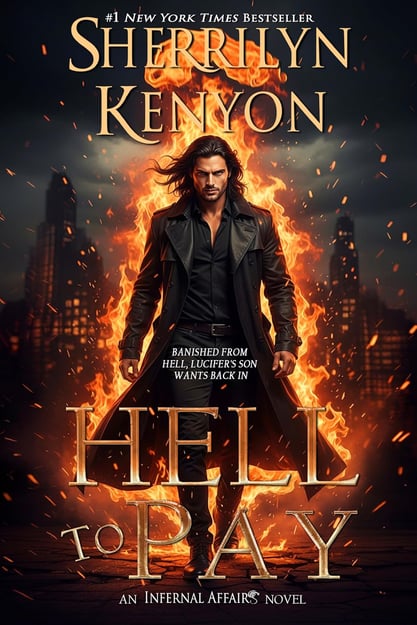
Immerse yourself in Sherrilyn’s hellish urban fantasy take on
Savannah, GA, in Hell to Pay
Compared to your earlier series, does Hell to Pay reflect a shift in tone or storytelling style you’ve been wanting to explore?
This is lighter in tone, even though it’s dealing with more serious matters such as murder investigations. But my style is my style, and it doesn’t really change much. Only the characters do.
Your readers often note how interconnected your universes feel. Do you consciously design those connections across books, or do they emerge naturally over time?
They just naturally emerge, such as the Dark-Hunter who suddenly appears in Hell to Pay. I had no intention of bringing in the DH universe, yet it made sense and is a fun cameo in the book. I hope my fans agree. But for the most part, I intend to keep IA separate from DH.
Your readership spans decades across your writing career. How has fan engagement changed from your early days to today’s digital and indie landscape?
I was the first author who went viral online in the 1990s. I also built the first book site with fan integration by way of chats, blogs, and boards where fans could interact with each other, me, and the characters. So really nothing has changed. I originally came online in the early 1980s when I worked as a civ contractor for the Army, then went to the dial-up services like AOL, Genie, Prodigy, Gopherspace, etc. In 1994, I was one of the first web developers in the country. So I’ve always been able to interact with fans online. The only thing that changes is the platform and the terminology.
What advice do you have for aspiring indie authors?
Never give up. Never surrender. Believe in your characters and your career. Never let anyone tell you that you don’t deserve your dream. Don’t let the turkeys pull you down.
You go out there and you make it happen and write the books your characters tell you to.
What do you hope readers take away from your work?
Books saved my life. Anyone who reads Acheron, Styxx, and many others can tell that I didn’t have a happy childhood or a happy adult life. I always say that it’s not the fictional parts of Acheron and Styxx that should bother readers, it’s the truth in them that resonates from the pages.
When I was a girl, a friend gave me a copy of Kathleen Woodiwiss’ The Flame and the Flower. In it was a heroine like me. Someone from an awful background who wasn’t wanted and barely tolerated. But instead of letting her abusers ruin her life, she found the strength to put her past behind her and become her own person. And in the end, she didn’t die. An important thing to note.
Writers have no idea how devastating it is when everything out there says that you cannot escape a bad childhood. That you’ll grow up impoverished, abused, die young or be a teen mom, etc. People need to know that they can make a better life for themselves. Hope is so important and it should never be taken for granted or stolen from someone.
That one book saved my life, and many others saved my sanity. I am well aware that there are others out there with worse stories than mine, and that breaks my heart. If I had one wish, it would be that no one goes to sleep afraid or praying that they won’t wake up because they can’t face tomorrow. That everyone receives the love they should.
If I can be that little beacon of hope, that laugh and hug when the reader needs it, then I’ve done what I wanted with my life. All I ask is to make someone’s life a little brighter and to be there when they need that hug. To make them laugh out loud.
What is the biggest risk you’ve taken in your writing career, and how did it pay off?
I was married for decades to an extremely abusive spouse. One so controlling that for years he forbade me from writing or sending out proposals. But I saw an ad in a writer’s magazine that an editor who was once my agent was looking for authors. I debated for several weeks before I finally decided to take a chance. But in order to send in my query letter, I had to literally steal a stamp from my ex’s wallet. I didn’t dare take two because I knew he counted them and if two were missing, he’d know I was sending out a query, and I would pay the price for disobeying him.
As soon as the editor received my query, she called my neighbor’s phone because we didn’t have one. The editor told me that she wasn’t interested in the Dark-Hunters as there was no paranormal market at the time, but she was interested in the pirate historical I’d pitched. She offered me a three book contract. I risked a lot at a very low point in my life to take that stamp. But had I not done it, Kinley MacGregor wouldn’t have been born and I would never have published Dark-Hunter, Nick Chronicles, League, Deadmen or any of the other series.
What does literary success mean to you?
Success is every time a reader comes up to me, hugs me and tells me that they loved something I wrote. It’s that simple. Everything else is a wonderful bonus. But hearing that I touched someone’s heart is all the success I’ve ever craved. I love my readers.