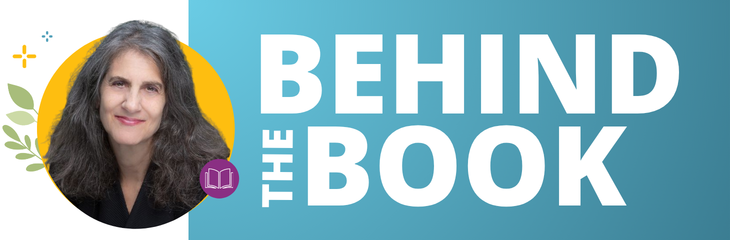
Jessica Keener's new novel, Evening Begins the Day, tells the story of two families drawn together in crisis discovering a path toward community and renewal. Her bestselling debut novel, Night Swim, was followed by an award-winning collection of stories, Women in Bed. Her second novel, Strangers in Budapest, was an Indie Next pick, an Entertainment Weekly best new book selection, and a Southern Independent Bookseller Association bestseller.
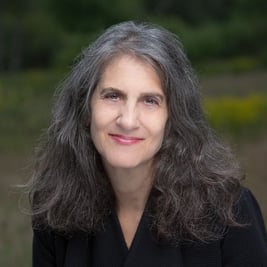
Keener has been the recipient of a Massachusetts Cultural Council artist grant, a Jakobson scholarship from Wesleyan University, multiple fellowships from the Virginia Center for the Creative Arts, and a women’s leadership fellowship from Omega Institute in New York. Her more than 100 features and essays have appeared in The Boston Globe, Agni, WBUR’s Cognoscenti, and many other national publications.
We talked with the author about the inspiration for her latest novel, writing from multiple POVs, and how fiction can help us organize the chaos.
What first inspired you to write Evening Begins the Day? Did the idea begin with the characters, a theme, the spiritual framework of the Omer, or something else entirely?
I wanted to explore the nuances of betrayal, how it shows up subtly and not-so-subtly in our closest relationships, such as marriage and parenthood. That was the emotional germ that propelled me to pursue this story and build a cast of characters—two husbands, two wives, one marriage with an at-risk teenage daughter, the other marriage without children—and have my characters manifest different variations of betrayal. The inspiration for the educator, the older, embittered high school principal, came as a surprise. He provided a kind of community voice for the novel. I also wanted to explore sexuality in an older woman in her fifties, and touch on issues of ageism and how these factors shape decision-making and life choices. I also knew I wanted to set the novel in present time. The inspiration for the Counting of the Omer came later.
The novel centers on two families whose lives become intertwined during crisis. What drew you to exploring parallel family struggles in this story?
I’m endlessly fascinated by what we don’t know about each other. In what ways do strangers, neighbors, family, and friends hide behind veneers of success, such as material possessions, professional degrees, status? Many times, I’ve imagined that a person who appears to have everything—a neighbor, a restaurant owner—is battling family troubles, money, or health issues behind closed doors. I wanted to break down these barriers of pretense by creating two families who lived next door to each other, who seemed to have it together professionally and economically, but don’t…as readers will quickly find out. And then, what happens when their defenses fall away. Can these neighbors who hardly know each other overcome their isolation? Can they shed their protective shells and, in their vulnerability, open up to each other in their time of need? What would that look like?
The practice of Counting the Omer becomes central to the novel. What inspired you to weave this ancient ritual into a contemporary narrative, and how does it serve as a throughline for the book?
How I came to the Omer was serendipitous. Maybe fated. I knew I wanted to add a spiritual element to my story—something that could provide a way for my characters to soften and trust, and find points of connection, but I didn’t know what that would be. Back in the spring of 2019, I was walking with my friend, another writer, who also happened to be an Orthodox Jew. I was telling her about an incident of kindness that had happened to me earlier in the day. A young college student and my son, also in his twenties at the time, had spoken openly and kindly to each other about their mental health struggles. Something about their mutual tenderness and honesty touched me deeply. My friend said their interaction reminded her of an ancient Jewish practice, the Counting of the Omer. I had no idea what she was talking about. I thought I knew all the Jewish holidays. I went to temple every week throughout my childhood. My grandmother was a devout Orthodox Jew. Yet, I’d never heard of it.
My friend explained it was a seven-week practice of self-reflection that took place every spring, starting on the second day of Passover. More than 3,000 years old, the practice often incorporated Kabalistic themes. I had heard of the Kabbalah and was intrigued.
After our walk, I ran to the Jewish bookstore in my neighborhood and bought a primer about the Counting of the Omer. As I read through it, and learned more about this simple practice of counting 49 days and its infusion of Kabalistic themes, I knew it was the spiritual thread I had been looking for. The fact that it provided a perfect framework for my story, and that each character could adopt it and use it to express their unique personalities and perspectives? I felt a gift had dropped into my lap.
Your novel is written through multiple POVs. As you’re writing, how do you decide whose voice should lead particular scenes or moments?
Honestly, it was an intuitive process for me. I didn’t map it out until much later in the revising stages. Initially, I wrote four points of view as they came to me, and that felt like enough. Early on, though, I didn’t worry about the narrative sequence until I had written individual scenes and dialogue, and felt comfortable with each character’s voice and interior life. Once I knew who my characters were, I made the decision to launch the story with Rachel discovering her husband’s emotional affair. From there, I let the characters guide me, but I made sure each character’s story arc interconnected with the others and with the novel as a whole. My wonderful editor at Koehler (Becky Hilliker) helped me see where I needed to add extra chapters or scenes to flesh things out. And, as always, I ordered the scenes to keep things moving in a way that I hoped would compel readers to turn the page.
Any behind-the-scenes stories you can share about creating this novel and world?
I can share that I wrote and threw out a full first draft. It sounds worse than it was. I still kept my basic themes about betrayal, trauma, and healing, so I knew I had a story, but my original cast of characters and storyline felt limiting. Once I realized that, I got rid of a few characters and introduced new ones—Rachel the betrayed spouse, and Lauren, the defiant yet promising teenage daughter—and it came alive for me in a way that felt more authentic and expansive. The new version also worked well when I wove in the Counting of the Omer.
Things that inspire me generally come from personal experiences, memories, and observations of others’ lives. Sometimes, a random incident like the act of kindness that happened to me in 2019, sparks a surprise and welcome addition to a storyline. I suppose there’s a little bit of everyone (and everything) I’ve ever encountered regenerating in my characters’ cells.
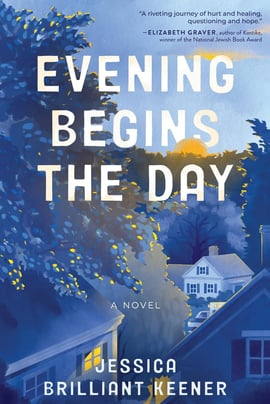
Check out Evening Begins the Day: an intimate, unforgettable story of two families finding hope through connection.
How did you decide on the title, and what does Evening Begins the Day mean to you?
Jewish holidays always start at sunset, meaning the new day begins when the old day retires. I was taken by this idea. What did it mean? When I set out to write this novel, I challenged myself to write something that would move from dark toward light, emotionally speaking. Evening Begins the Day captures that idea for me, while also echoing the Jewish tradition of demarking a new day when night falls. It seems almost backwards or counterintuitive, yet it strikes me as cyclical—as if all things (time/space/people, earth, sun) are linked in a continuous circle of life.
What do you hope readers will take with them after reading this book?
I hope readers will relate to the characters and carry their stories with them for years after they’ve read the last page of the novel. I hope they experience my characters as people who, like them, are muddling along in the pursuit of love and healing, and that by having a front row seat to my characters’ secrets and yearnings, readers will feel less alone. I hope too that readers will feel compassion for my characters’ flaws and see the strength and resiliency inherent in my characters’ vulnerabilities. Finally, I hope readers will be curious about the Counting of the Omer and feel inspired to try it with a friend or a group, as a way to reflect and embrace their own imperfect lives.
Do you have any writing or creative habits that have become essential to you?
I work well in my office at home, and prefer a quiet space. As long as I have a table, a pen, a laptop, printing paper, yellow legal pads, file cards, plus time in a quiet space without interruption, I can write and get my work done. I’ve worked well at writing retreats. The Virginia Center for the Arts is a wonderful place. I also hand write in journals, almost every day. I’ve been doing that for decades. The book I’m working on now (a memoir about a fatal illness I had in my early twenties), relies heavily on my stacks of detailed diaries that I kept during that time. I also know that even when life is most trying, I can carve out time to write. Sometimes that may mean only 30 minutes in the morning, but if I’m working on something long, like a novel, I need to show up at least five days a week. I’ve learned that continuity is key.
What do you love most about being an indie author?
The feeling of being in control of my work, and the spirit of collaboration that infuses every interaction I’ve had with my editor and designer and the whole Koehler team. It’s freeing.
In a time when many people feel disconnected or overwhelmed, what role do you think fiction can play in helping us understand one another?
Fiction is a safe yet exhilarating way to enter other people’s lives. It’s a vessel for sharing our universal troubles, confusions, joys, questions, and answers via the medium of storytelling. I think storytelling is innate to humans. It’s a way of organizing the chaos we often feel knocking at our back doors, and a tonic to isolation and disconnectedness. It can be a gentle teacher, offering insight and guidance, fun, and stimulation. It encourages explorations of ideas, and reveals our deepest feelings. If you can enter other people’s lives, you can begin to understand them. If you can understand someone who is vastly different than yourself, then you can experience compassion. Suddenly, what seemed different or other, scary and unknown is no longer foreign, but simply another side of who you are—who we are—as we travel together along this vast and mysterious river of existence.