Supernatural horror author Ben Farthing is known for his incredibly unique storytelling and original ideas, masterfully illustrated in his popular I Found Horror series. His most recent release, The 31st Trick-or-Treater, serves as an advent calendar for Halloween with 31 chapters making up the bone-chilling, suspenseful tale.
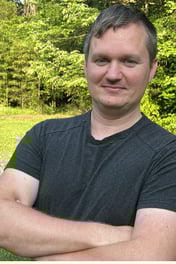
Farthing has an MFA in Creative Writing from BYU and is a graduate of the Viable Paradise writer's workshop. In each of his books, he's trying to recreate the sense of wonder and dread that he got the first time he saw Clive Barker's Hellraiser or read Stephen King's The Mist. He lives near Richmond, Virginia, with his family and too many pets.
We talked with Farthing about his advice for future indie horror authors, what makes the perfect horror novel, and why liminal spaces creep him out.
Why did you decide to publish independently, and what’s been the best part of the indie author experience for you?
A friend from a workshop encouraged me to self-publish one of my manuscripts, and I found I really enjoyed the marketing side of things. The best part of being an indie author is the complete creative control. I set out to create a specific emotional experience for my reader, and at the end of the day, I get to decide every moment of that from the core idea of the book, to the sentence-by-sentence decisions, to the title and cover. I get to create exactly the piece of art I want to create.
What piece of advice would you give future indie horror authors?
The cover, title, and core idea of the book are EVERYTHING. Those three are how readers decide to pick up your book. You've gotta' hook them with those three. Effective ads, viral videos, word-of-mouth—those only happen once the cover, title, and core idea of your book are honed in. (And usually, cover and title only happen once the core idea is honed in.)
What sparked your interest in writing supernatural horror? Has it always been your go-to genre, or did you explore others along the way?
I was a 90s kid obsessed with Goosebumps. I went straight from that to Stephen King’s short stories. So, when we started writing stories in elementary school, and when I got really into it in high school, I wrote what I read, which was supernatural horror. I also enjoy fantasy. I read a lot of fantasy, especially the weird and complicated stuff like Steven Erickson or China Mieville. I’ve written an epic fantasy novel and an urban fantasy novel. I might get back to writing that genre one day.
What do you think are the key components of a perfect horror book?
Characters who are already in emotional peril before any of the creepy stuff starts. And then in terms of the actual creepy stuff, I love horror mysteries. Not “who murdered this ghost?” but “why does my hallway suddenly have an extra door?” or “why are there puppets living in my walls?” or “why did 30 trick-or-treaters vanish last year?” And most of all, I crave NOVELTY in my horror. Show me something creepy I haven’t seen before.
Your work is often praised for its unique and original ideas. How do you come up with your stories and characters? Has your creative process evolved over the course of your writing career?
Some of my ideas come from nightmares—that’s true of I Found Puppets Living In My Apartment Walls and I Found Christmas Lights Slithering Up My Street. Others come from an image or idea I swipe from someone else’s work. I Found a Circus Tent in the Woods Behind My House came from that image at the start of Killer Klowns from Outer Space (of course it immediately goes in a wildly different direction).
I think it was Stephen King who advised stopping halfway through reading a story and guessing how it ends. Then, if it ends differently, your guess is now a new story idea. I do that all the time.
My characters come after I have the idea of the horror. I either create someone based on my own current mental struggles (which is why so many of my books are about elder millennial angst), or I create a character who would be the absolute worst person to be forced to confront the horror I’ve invented. People who are not emotionally ready to handle giant puppets, or creepy mannequins, or elder gods who feed on overconsumption.

Your most recent release The 31st Trick-or-Treater features a distinctive structure fitting for the Halloween season. How did that idea come to you?
The 31st Trick-or-Treater is a Halloween advent calendar book, so each chapter is a day of October. You can read one chapter per day, and go throughout the month alongside the characters, all the way up to Halloween. The story is that last year, 30 trick-or-treaters disappeared. This year, they’re returning, one per day. A family who lost a daughter and never stopped looking for her now suddenly have hope again, but they must confront the evil that took the children.
The idea for a chapter-per-day holiday book isn’t mine. Roger Zelazny wrote a Halloween one called A Night in Lonesome October, although I didn’t learn about that until a few weeks ago. Per Jacobsen published a Christmas advent book last year called 25 Days. I saw that and thought it looked fun, so I messaged him and asked if he was planning on doing the same thing for Halloween this year. I was willing to wait a few years to write my own to avoid stepping on his toes. But he was excited for me, wished me the best, and he and his wife, Sarah (who does his marketing) have been extremely gracious and helpful in my own writing and marketing for my book.
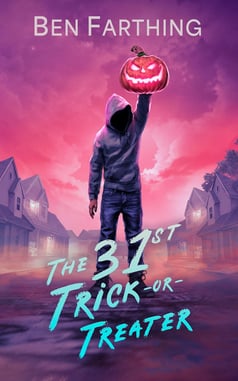
Check out Ben’s latest page-turner The 31st Trick-or-Treater, a Halloween read that pulls you in, one chilling chapter at a time!
But here’s the thing about really cool story ideas: they’re not the story.
Even once I came up with the premise about the missing kids returning, that’s not a story. A story is about characters trying to achieve something. I had to invent this family who’d lost a daughter. I had to create these characters who’d been either grieving or searching for their daughter for the last 11 months. I had to create a whole neighborhood of people who’ve all reacted differently to their kids disappearing, or their neighbor’s kids disappearing. And I get bored if I’m not exploring some kind of theme, so I came up with something that fit the book and worked that in while I was writing.
You often explore the eerie tension of liminal spaces in your horror. What draws you to that idea, and why do you think it’s so effective? Do you have any favorite examples from your own writing or another work that inspired you?
I’ve been creeped out by liminal spaces ever since reading House of Leaves 20 years ago. And usually when I say I love liminal spaces, I don’t only mean the technical definition of “in-between spaces” or “transitional spaces” like hallways, vestibules, stairways, etc. I mean the internet horror definition which has evolved to mean those sorts of spaces made wrong in some way, often through becoming infinite mazes. There’s often a sense of nostalgia and loss associated with them.
It's my desire for supernatural mystery in horror. I want to know what’s around the next corner in the maze, even when I know it’s only going to be more corners. And then if suddenly the maze doesn’t make spatial sense anymore? I love it.
From my own work, I Found Puppets Living In My Apartment Walls, the characters go inside the walls pretty early in that book. And also I Found a Lost Hallway in a Dying Mall is about a woman searching a mostly-empty shopping mall for an old friend who needs help, and she quickly finds spaces that don’t make sense.
My favorite examples from others: The YouTube creator Kane Pixels has a series called The Oldest View about exploring an empty mall that is one of the scariest things I’ve seen for a while. Found: an Anthology of Found Footage Horror Stories has some great liminal horror in there. This concept is sometimes most effective when it’s only in the background of a story. There’s a Stephen King novella called The Breathing Method which has a frame story of a storytellers’ association in a creepy building that may have infinite hallways upstairs. Just that hint of liminal spaces has stuck with me for decades.
What is your favorite compliment you’ve received from a reader?
One reader said that my book I Found Christmas Lights Slithering Up My Street helped them realize that—even during grief—they needed to remember their loved ones who were still with them. That’s a theme I explored in that book, so it was really cool to see that my strange little book helped make a few people’s lives better.
What’s an unpopular opinion you have?
Common tropes are boring. Why would I want to read the same thing over and over? (Except for the tropes I love, of course. Those don’t count.)
In honor of Halloween, do you have any traditions around spooky season?
Nothing too unique—costume parties and pumpkin pies and watching my favorite scary movies. I have young kids now, so we have fun sneaking into the neighborhoods with the best candy.