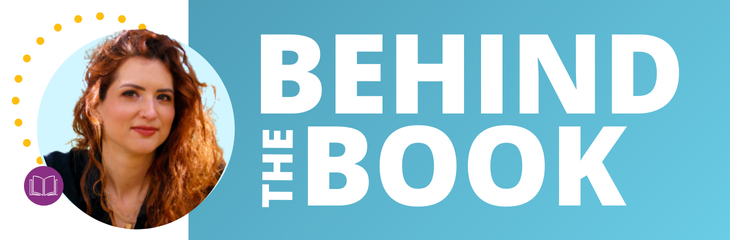
Kristina Ten is the author of Tell Me Yours, I'll Tell You Mine (2025, Stillhouse Press). Populated by living paper dolls, summer camp legends, and trivia nights gone terribly wrong, the 12 genre-crossing tales in her debut collection wrestle with themes of memory, disobedience, alienation, belonging, and the horrors of inhabiting a body others seek to control.
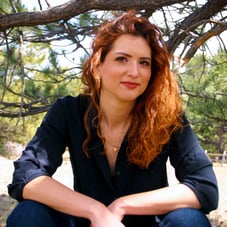
Her stories appear in The Best American Science Fiction and Fantasy, We're Here: The Best Queer Speculative Fiction, The Best Weird Fiction of the Year, and elsewhere. She has won the McSweeney's Stephen Dixon Award, the Subjective Chaos Kind of Award, and the F(r)iction Writing Contest, and has been a finalist for the Shirley Jackson Award and the Locus Award. Ten is a graduate of Clarion West Writers Workshop and the University of Colorado Boulder's MFA program in fiction, and was a 2024 Ragdale Foundation writer-in-residence.
We spoke with the author about her writing journey, how cuddly little bunnies can also be scary, and who and what inspire her.
Congratulations on publishing your debut collection Tell Me Yours, I’ll Tell You Mine! How was your experience working with Stillhouse Press?
I came to Stillhouse Press via a manuscript contest judged by Joe Vallese, the editor of the awesome queer horror anthology It Came from the Closet. Vallese ended up selecting my book, which was going by a different title at the time, from the stack, and I spent the next year or so working with the Stillhouse team on everything from edits to cover design to publicity. I love that Stillhouse is a teaching press, which means students across disciplines related to book publishing are involved in every step of the process. It’s something I really believe in, and I feel fortunate to have worked with such a robust, enthusiastic team.
You have such a specific point of view and unique style of writing. How did you hone your voice? Have you always been interested in the genre of speculative fiction and horror, and what drew you to that space?
I have two creative writing degrees, and I joke with my friends that I don’t know how to do much else. I’ve wanted to be a writer since I was very young. I wrote these little adventure books when I was a kid, then angsty poetry as a teenager, then in undergrad I thought I would be a travel writer, following in the footsteps of Anthony Bourdain, who I really idolized at the time. After college I wrote mostly poetry, specifically poems meant to be performed aloud, and I was doing that in various bars and backyards across the Bay Area. I came to speculative fiction and horror in my twenties. Well, I’d been reading those genres all my life, and I finally started writing them. They unlocked something for me. That’s how I was already experiencing the world: the most magical and horrifying things getting tangled up in the everyday.
Is there a particular challenge or freedom to writing in the short story format vs longer-form? And what makes you excited to experiment with different forms within that space, such as in “ADJECTIVE?”
Short stories can be a great playground, because you don’t necessarily need to commit a novel’s worth of time, or all that plot or worldbuilding, to the premise or question you’re interested in exploring. I once wrote a story in which one of the characters speaks only in product names (called “When It’s Over (No-Tears Shampoo)” in Split Lip Magazine). That would’ve been a much different project had it been a novel. I’m drawn to stories that feel like a game, or that’re interactive or somehow formally inventive. As a reader, I love the feeling of forgetting that I’m reading static words on a page and feeling instead as though I’m part of what’s happening. So as a writer I aspire to create that feeling for readers. I hope the Mad Libs prompts in “ADJECTIVE” can break a wall and help readers understand that, hey, yeah, they’re part of this.
Do you have a favorite short story in the collection, or one that was particularly interesting or rewarding to write?
I wouldn’t say so. The project as a whole compelled me. These days, I feel a certain fondness for the stories that appear in the collection for the first time—that is, the ones not published by journals beforehand, that’re now finally making their way into readers’ hands. “Mel for Melissa” is one. I’m proud of it. I think it gets at something true. But it’s also in a slippery place genre-wise, and it’s quite long, technically a novelette, and those kinds of stories tend to be hard to place with journals.
How was your experience synthesizing a dozen pieces together? Did you struggle to decide where each should be within the book’s full arc, or did they naturally fall into place?
The stories in Tell Me Yours, I’ll Tell You Mine are arranged such that their protagonists gradually age, from school-age kids in the front half of the collection to adults in the back half. Ordering the stories was a bit of a challenge, since they vary in genre (horror, fabulism, sci-fi) and also in length (from 500-word micros to novelettes). But it was a fun challenge, like a puzzle. The pieces were all there on the table; I just had to move them into the right place.
What inspired you to write around these themes of games, folklore, and childhood? How did you craft a sense of dread and unsettling eeriness alongside such typically bright and nostalgic topics?
I’ve always been drawn to folklore and fairy tales, especially those of cultural relevance to me, the ones I grew up with and modern, feminist, and queer twists on those. This collection’s focus on childlore, or the folklore of our youth—all those games, rituals, superstitions, pranks, riddles, and rhymes we took part in—is an evolution of that. From an interest in geographically specific folklore toward an interest in age-specific folklore, I suppose. I don’t find that folklore to be sweet or cheerful or anything like that, just because it resides in the realm of children. The opposite: it’s quite dark, isn’t it? We played pain-tolerance games like “Bloody Knuckles,” and ghost-summoning games like “Bloody Mary,” and we performed death-divination rituals like “Concentrate, Concentrate.” So, I think the darkness is already there. Same with nostalgia. I don’t experience nostalgia as pleasant. I find it to be quite a sad, uncanny, disorienting feeling, and a dangerous one, easily weaponized as it is.
-jpg.jpeg?width=233&height=360&name=TellMeYoursIllTellYouMine_KTen_ARCCover%20(1)-jpg.jpeg)
Dive into Kristina Ten’s beautifully twisted debut collection Tell Me Yours, I’ll Tell You Mine!
Tell us about the incredible cover and how it represents this collection, particularly the story “Bunny Ears?”
Camille Koslo designed the cover. She knocked it out of the park. “Bunny Ears” is a horror novelette that comes in right around the middle of the collection. It’s set at a run-down summer camp, amid all the vicious boy-on-girl pranks and spooky bonfire legends you’d expect, plus a monster or two you might not. Rabbits show up a lot in horror (think Donnie Darko, Five Nights at Freddy’s, Bunnicula, Us, just for starters). There’s something about their scared, jumpy eyes, and the way their ears are shaped like scissor blades. Also, that they’re so soft and cuddly, right at the bottom of the food chain, so there’s that subversion when prey becomes predator, or when domesticated becomes feral. I love that the bunnies on this cover have cut-out eyes, because paper, as a recurring motif, is important to the collection, too. Hence, the very cool and creepy paper dolls holding hands in a chain on the back cover.
What do you hope readers learn, think about, or take away from reading this collection?
I hope any book about games invites thought and discussion around rules, which all games, at least all the games I know, are bound by. When did you first believe that following the rules, in your life, would keep you safe? When did this belief first let you down? This book’s protagonists find themselves on the margins of society; they are immigrants, first-gen kids, women, queer people. But whether or not readers align with any of those identities, I think we probably all find ourselves asking these questions: Who makes the rules? Who do the rules serve? And what do we do with rules that (and rule makers who) no longer serve us?
What’s next for you?
I’m working on a supernatural horror novel. I can’t say much more about it, besides that writing a novel is very hard and I’m in awe of everyone who has done it.
Who inspires you the most, or when are you most inspired?
I’m inspired by other writers and artists, of course, who pursue their work and seek beauty in a world that is often hostile to both creative work and to beauty. I’m inspired by anyone who lives a life guided by curiosity and ferocious sincerity. I feel inspired walking through incredibly loud, bright, harsh, dense, fragrant cities, and also sitting quietly amid the overwhelming wildness and stillness of a place like California’s high desert. Deserts are my environment.