
Many authors think their job ends once their book is published, but your manuscript is actually a bundle of valuable rights just waiting to be unlocked. Whether it's a film adaptation, a translated edition, or a merchandise line, your intellectual property (IP) is your most powerful business asset. Here's how to protect and and grow it.
Understanding Your Assets
What Exactly Is Your IP?
Your Manuscript
-
-
Your manuscript is protected by copyright as soon as you fix it in a concrete form—like a document or digital file.
-
You automatically own the rights—you don’t have to publish or register your work first. That said, registering with the U.S. Copyright Office can give you much stronger legal protection and make it easier to take action if someone uses your work without permission.
-
Character Names and Relationships
-
- To strengthen your brand, focus on developing distinctive, well-developed characters that readers can easily identify.
-
-
You typically can’t copyright character names by themselves, but they are protected as part of your original storytelling—especially within your specific plot, world, and character development.
-
-
- If you plan to use specific names heavily in branding or merchandising, consider seeking trademark protection to prevent others from using those names in commerce.
- Using unique traits and relationships consistently across a series helps establish your characters as valuable assets that can eventually be licensed for other formats.
Series Title & World-Building
-
- Unlike a single book title, a series title can be trademarked as a brand once it appears in two or more works.
- Use distinctive characters, names, and traits consistently across your series to strengthen your copyright protection and brand identity.
- You can’t copyright broad tropes (like “wizard schools” or “hockey romance”), but you can protect your unique expression of them: your specific settings, magic school rules, history, and all the key details that make your story yours.
Your Pen Name & Author Brand
-
-
You can register your copyright under a pen name, but using your legal name with the U.S. Copyright Office often makes it easier to clearly show ownership in official records. Even if you choose a pseudonym, your work can still enjoy long-lasting protection—up to 95 years from publication or 120 years from creation.
- Before you commit to a pen name, take the time to search it on Amazon and Google in order to avoid any potential conflicts. If it’s available, go ahead and grab the matching domain, email, and social handles to keep your author brand consistent everywhere readers find you.
-
-
-
In addition to copyright, you may also want to look into trademarking your pen name, series titles, logo, or imprint name. This can give you stronger tools to prevent others from using them in related commercial projects and help you build a more secure author brand over time.
-
Cover Art
-
-
Just like your manuscript, your cover art is automatically protected by copyright as soon as it’s created. If you’d like to strengthen your legal protection and create a clear public record of ownership, you can also register it with the U.S. Copyright Office.
-
If you hire a cover designer, put your agreement in a clear written contract that spells out who owns the artwork and transfers the rights you'll need, especially if you plan to reuse the design on merchandise, in ads, or across formats.
-
Derivative Works Potential
-
- Derivative works include a wide range of formats such as:
- Foreign language translations
- Film, television, or stage adaptations
- Graphic novels, comic book, or gaming versions
- As the creator, you keep full control over how your manuscript is used—including the right to reproduce, distribute, display it, and develop new versions like translations, film or TV adaptations, stage plays, graphic novels, or games.
-
When you share your work with agents, editors, or producers, it’s a good idea to use NDAs (non-disclosure agreements) or clearly written submission terms to help prevent unauthorized adaptations.
-
If you decide to sign with a publisher, give yourself plenty of time to look over any adaptation-rights clauses, and aim to either keep those rights or set clear, friendly but firm limits on the scope, duration, and territory of any license you grant.
- Derivative works include a wide range of formats such as:

Inside the Rights Bucket: Your Revenue Potential
Before we move forward, let's take a quick look at what "rights" actually are.
Monetization Potential
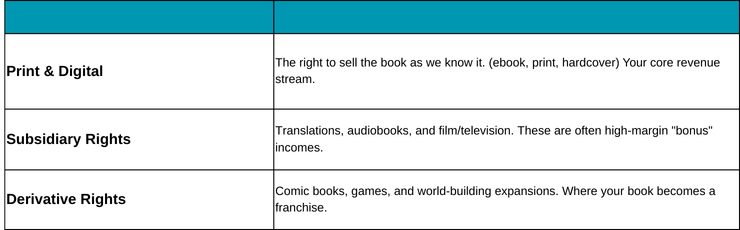
Keep in mind that these rights are also divided by territory. For example, you can grant a publisher the right to publish your book in the UK while still keeping the rights for the U.S.
PRO TIPS:
💡Never sign a contract that asks for "All Rights in Perpetuity." In the world of IP, you want to license specific rights for specific amounts of time. Keep as many "buckets" of rights in your own hands as possible.
💡Whenever possible, ask for a "Reversion of Rights" clause. This way, if a publisher ever stops selling your book, the rights automatically return to you so you are free to republish it yourself.
Protection & Strategy
Thinking like an IP owner doesn’t mean abandoning your craft; it means adding a strategic business layer on top of it. It requires transitioning from a "content creator" mindset to an "IP manager" mindset, where you see your book not just as a product to sell, but also as a foundation for a broader, multi-platform brand.
A Case Study
Understanding the legal “buckets” of IP is one thing—but seeing them in action is where it really starts to click. To make it easy to see how one story can grow from a simple digital file into a lively, long-term revenue engine, let’s walk through a hypothetical indie success story:
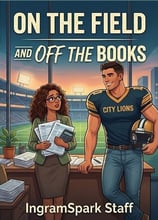
For the remainder of this article, we'll use the working example of a hypothetical indie success story: On the Field and Off the Books—a romance novel about Chloe, a nerdy tax preparer who falls for Colton, a sexy football star, when she’s hired to help him get out of trouble with the IRS.
Things to Consider
In our example, On the Field and Off the Books, we automatically own the copyright to the story, characters, dialogue, and plot the moment we write it. That said, there are a few specific things to keep in mind:
Character Names:
-
-
Chloe and Colton are fairly common names, so that shouldn't create any issues.
-
It's actually the relationship (Nerdy Tax Preparer + Sexy Football Star) that's the unique "hook" that makes this specific IP pitchable for film or TV adaptations.
-
Keep in mind that if Colton plays for a real NFL team, you’re stepping into trademark territory. To avoid conflicts with the NFL or real teams, create a fictional league or team. This allows you to own the team's branding and colors for future merchandise.
-
Copyright Registration:
-
-
Even though copyright arises automatically, formally registering with the U.S. Copyright Office gives you much stronger legal footing if someone copies your work.
-
It’s relatively inexpensive and generally worth doing, especially if you plan to build a series or broader brand around the book.
-
The IRS Angle:
-
-
Using the name of a real government agency (like the IRS) is typically fine, but keep the focus on the fictional drama to avoid any "defamatory" territory.
-
Character Trademarks:
-
-
If Chloe and Colton were to become breakout characters, you might eventually be able to trademark their names or taglines in connection with specific goods and services (such as merchandise, games, or a spin-off series).
-
This is something you can plan for early, even if you don’t file immediately.
-
The key takeaway: Chloe and Colton aren’t just characters; they’re valuable assets to your story and brand. The more distinct, consistent, and lovable you make them, the more potential they have for licensing, merchandising, and future spin-offs. When you invest in strong character development and clear brand positioning now, you open the door to many more opportunities down the road.
Monetization & Merchandising
Each book genre offers up unique merchandising ideas, as seen in this example below:
| Genre | IP Extension Ideas | Merch Inspiration |
| Romance | Translation Rights, Bonus POVs | Character Art Prints, "Book Boyfriend" Candles |
| Fantasy | Map Licensing, Graphic Novels | World Maps, Enamel Pins, Special Editions |
| Mystery | Film/TV Options, Prequels | "Evidence" Files, Magnifying Glass Bookmarks |
| Nonfiction | Workbooks, Online Courses | Branded Planners, Professional Toolkits |
As a quick side note here, romance is especially powerful here, because romance readers tend to be incredibly loyal and eager to support their favorite authors in multiple formats.
Some of the options for monetizing your book include:
The Book Itself
- Publish in multiple formats to reach more readers. Start with an ebook, print-on-demand edition, and audiobook.
- Consider developing a connected series featuring teammates or coworkers as leads in their own spinoff romances.
Digital & Content
- Set up a Patreon or Substack where readers can enjoy bonus scenes, deleted chapters, or "what happened next" content. (Romance readers love these extras).
- Build a BookTok and/or Bookstagram presence that highlights Chloe and Colton's personalities and invites readers into their world.
Licensing Your IP
- Translation rights for foreign markets: romance translates exceptionally well with readers all over the world.
- Film or TV adaptation rights: an IRS-meets-NFL is genuinely a fun, marketable romcom concept.
- Audiobook licensing to platforms like Audible and other listening services.
Merchandise
Fun ways to bring your story into the real world might include:
- Apparel featuring character quotes or signature personality traits.
- Bookish merch such as character art prints, bookmarks, tote bags, candles, and mugs .
- A "Colton's jersey" style item, once you've built up a strong fanbase.
Expanded Universe
- A bonus companion novella from Colton's point of view
- A prequel that shows how Chloe first got into tax prep
The Key Takeaway: Licensing is renting your IP, not selling it, and that distinction can completely change your long-term opportunties.
Did You Know? Many indie authors make more from Subsidiary Rights (like selling foreign translation rights to a German or Brazilian publisher) than they do from their original English ebook sales.
Building a Franchise, Not Just a Backlist
Many authors think of their "backlist" as a graveyard of past projects. But when you think like an IP owner, your backlist becomes the foundation for a potential franchise. The idea is to build a rich "storyworld" that can be licensed for film, translated into multiple languages, or expanded into high-end merchandise, while you still keep creative control.
You don't need a huge legal team to do this, just some intention and planning. And you don't have to be Emily Henry to make it work. Even a mid-list series can grow into a franchise if you start thinking about it early.
The Franchise Blueprint
-
Create a Story Bible: Take the time to document your world's rules, character histories, and specifics (e.g.Chloe's favorite brand of tea or Colton's jersey number). This not only keeps your story consistent, but it also makes it much easier for future licensees to understand and fully step into your world.
- Retain Creative Approval: When you enter into any licensing deal, be sure to include clear "quality control" clauses. This gives you the right to review and approve scripts, character art, or merchandise designs to make sure they align with your original vision.
- Engage the Superfans: Invite your most dedicated readers into the process. Platforms like Patreon or social media are great places to let fans vote on world-building details. You'll deepen your community connection while also building a ready-made audience for future franchise expansions.
- Think Visually: Even if you're not an artist, consider commissioning professional concept art for your characters and settings, Strong visuals help producers, directors, and illustrators immediately "see" the TV show, film, or graphic novel potential. You can find experienced character animators and illustrators online who can bring your vision to life.
The Franchise Strategy (for our case study)
To grow this romance into a full franchise, you could:
-
Create Series Spin-offs: Rather than writing a direct sequel to your book, consider launching a "Teammates" series. Each book could feature a different player on Colton's City Lions team, turning a single book into a universe.
- Incorporate Visual Branding: Commission character art of Chloe and Colton to use on your social media channels, to create a recognizable "look" for your brand.
- Create Branded Merchandise: Build a "Team Store" featuring City Lions apparel or Chloe's Tax Service coffee mugs. This allows readers to "wear" the story and feel even more connected to your world.
🌍 Global Perspective: Remember Your Moral Rights: If you're publishing outside the U.S. (especially in the UK or EU), you also hold "Moral Rights." These include the Right of Attribution (the right to be named as the author) and the Right of Integrity (the right to prevent changes that could harm your reputation). Some contracts may ask you to "waive" these rights, so be sure to take a careful look. Always read the fine print before you sign.
Conclusion: Your Story is Your Asset
Writing “The End” is really just the start of your journey as an IP owner. When you shift your thinking from simply selling books to managing a portfolio of creative assets, you open the door to global readers, new formats, and long-term brand growth. Whether you’re working with Chloe and Colton today or dreaming up a brand-new world tomorrow, remember: every decision you make is a smart investment in your future creative empire.