Jacquelyn Benson writes smart historical fantasy in which strong women confront the stranger things that occupy the borders of our world. Her newest release, Arrow of Fortune, is the third installment of her Raiders of the Arcana historical fantasy adventure series.
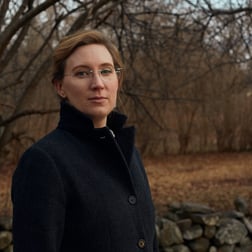
She once lived in a museum, wrote a master’s thesis on the cultural anthropology of paranormal investigation, and received a gold medal for being clever. She owes a great deal to her elementary school librarian for sagely choosing to acquire the entire Time-Life Mysteries of the Unknown series. When not writing, she enjoys the company of a tall, dark, and handsome English teacher and practices unintentional magic.
We talked with the author about why she loves writing historical fantasy, her paranormal experiences, and what she hopes readers take away from her stories.
What has been the most rewarding part of your experience as an indie author?
For me, it’s knowing that I get to write and release the books I want. A series like the Raiders of the Arcana might have struggled to find a place in traditional publishing because they’re adventures written primarily for women, and adventure is a genre that’s been dominated by men for a long time. I probably would’ve been told to tone down the romance and publish under a less gender-specific name. As an independent author, I can bring the books to life anyway. The audience is there—it’s just harder for a big publisher who has to lay out a lot of cash on a project to justify that when they can’t see how similar books have performed recently in the market.
What draws you to historical and international settings in your fantasy work, and what role does research play in your creative process?
I’ve always been an enormous nerd for history and for learning about other cultures and ways of life. Writing historical fantasy gives me the perfect excuse to indulge my curiosity. There’s so much research—I have to rein myself in to keep from going down all of the most delicious rabbit holes. For the Raiders books, I spend a lot of time reading broadly about the settings and getting that overall historical context into my brain before I go diving into all the juicy stuff, like the politics of colonial accounts of human sacrifice in Central America, or Middle Egyptian pronouns, or little-known variations of the Ramayana.
You wrote your master’s thesis in cultural anthropology on paranormal investigation. How does your scholarly past inform your work, and how did that thesis influence the magical elements of your Raiders of the Arcana series?
Let’s just say I’ve always been into the weird stuff. I grew up in a haunted house. I’ve recorded ghosts on tape. I know people who’ve had prophetic dreams or chatted with dead people. There’s a whole tangent I went down in my thesis about how the current paradigms of science just don’t know what to do with psychic and paranormal phenomena, because under most circumstances the evidence for it is unavoidably anecdotal. You can’t repeat a ghost encounter on command in a lab. And yet there are so many people out there who’ve experienced these things, and I’m fascinated by their stories.
In both my Raiders of the Arcana and my London Charismatics series, the concept of the world is to ask the question, “What if the magic powers and mystical objects from folklore and mythology were real?” and then marry that to all of the supernatural phenomena people report experiencing today. I take the liberty to exaggerate a bit for dramatic purposes here and there, but as much as possible I’m always trying to root the fantasy in those historical records and contemporary accounts. For me, that makes the stories walk this lovely edge between fantasy and realism. Maybe because things are so grounded in research in real experiences, the books can push the boundaries of the world out a little wider for readers and make it easier to look for magic in our own lives.
Tell us about your most recent installment in the series, Arrow of Fortune! What inspired you to set this novel in India and weave in South Asian mythology?
I’m afraid that one of my characters, the redoubtable Maharajkumari Padma Devi, is responsible for Arrow of Fortune. She turned up at the end of book two and more or less demanded that we go to India. I was left to fill in all the blanks from there, but I’ve loved having an excuse to dig into India’s history. It’s such a richly fascinating and complex part of the world.
I will also admit that, as someone who always loved the Indiana Jones movies, the racism and stereotyping in Temple of Doom hurts. I wanted to do better with Arrow of Fortune and show that we could have this classic swashbuckling fantasy adventure in India while still acknowledging the harm of colonialism and respectfully representing the history and culture. That’s why we see Kali in the narrative. She was always going to be part of the story, even before I stumbled across some old manuscripts that gave me even more of a reason to include her. (Which I won’t name here, because *spoilers*.) Popular western media has turned her into this boogeyman, but she’s so much more than that, and if the book has gone some little way towards correcting those injustices, I will be happy.
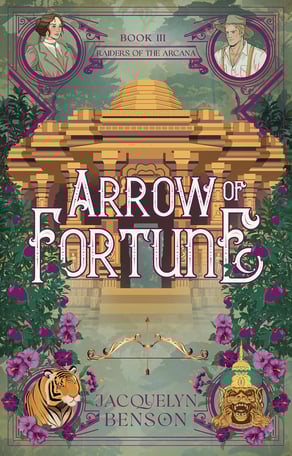
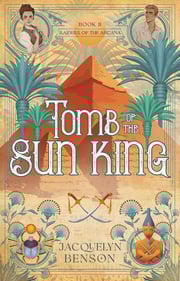
Take a thrilling trip back in time with Jacquelyn’s Raiders of the Arcana historical fantasy series: Empire of Shadows, Tomb of the Sun King, and her newest release Arrow of Fortune

Speaking of Indiana Jones, this series is often compared to that franchise as well as The Mummy – does this resonate with you? And do you have a favorite classic historical adventure from books or film?
I’ll take the comparisons, especially with The Mummy, otherwise known as “the greatest movie of all time.” I grew up on Indiana Jones, but I always wished that those stories centered real history and gave more voice to the people from the cultures we were adventuring through. I honestly believe that weaving more truth into the fantasy can actually make things more fun.
I’d say that the Elizabeth Peters books were also an influence on the Raiders of the Arcana. That’s still one of my favorite series, and the dynamic between Amelia and Emerson is timelessly delightful.
Why is it important to you to craft such formidable heroines, and how do you approach portraying women who defy the limitations of their historical eras?
I get this all the time from reviewers. They’ve called Ellie and Constance “anachronistic,” and I’ll fight that label to the death. There is nothing anachronistic about opposing marriage or calling out the injustice of women’s exclusion from professional life. Ellie doesn’t say anything more radical than what you’d find in the writings of Mary Wollstonecraft or John Stuart Mill. Constance’s jiu jitsu classes are based on trainings given to actual suffragettes in London during the time period. Nor is it fantasy to think that there would be Victorian men who acted as their allies. You can find their names in the history books. We didn’t get the right to vote, or receive equal pay, or access financial institutions, or escape harmful relationships from generations of women who bowed their heads to the dominant paradigm. It’s the rebels who made change happen (and still do.) So how do I approach portraying these women? By rooting them in the real history of resistance and the fight for justice.
You once lived in a museum called Hamilton House. How did this experience caretaking historical property influence your sense of history, architecture, and world-building in your fictional work?
To be clear, our caretaking responsibilities at Hamilton House mostly involved chasing the squirrels out in the wintertime. The wonderful conservators at Historical New England did all the real work. But living by such a beautiful historic property was definitely inspiring. Inspiring… and cold. We still had horsehair insulation and 19th century windows. We made good use of hot water bottles. It probably would’ve been less cold in the 1840s, but they had wood stoves in the place back then. We weren’t allowed to build fires in the priceless historical treasure. Go figure.
What do you hope readers learn, think about, or take away from your stories?
World-traveling adventure stories are historically a colonialist narrative, just like anthropology was—for a very long time—a colonialist discipline. That’s why it’s been so important to me that all of these stories are set in places that are late 19th century colonial projects. Most of my readers are from the countries that did the colonizing. We aren’t taught about the harm that caused, or how our own economies benefited from it. (Though it was generally the already-powerful who profited, while the rural and working classes paid their own price.)
I want Ellie’s feminist struggles to illustrate where we’ve come from as well as the distance we still need to go. I want characters like Adam and Neil to embody a different kind of masculinity that can be powerful and sexy without being dominant or oppressive. I want to bring people of color and queer people back into the lens of history, and try to voice them in a way that is both authentic and empowering. And while we’re doing all that, we’ll immerse ourselves in these fascinating and beautiful places, exchange piles of witty banter, ratchet up the romance, and play with a bit of magic. So yes, there’s absolutely a secret woke agenda. You’ve been warned.
What are you working on now, and can you tease anything about your next book?
I’m already fully into book four of the Raiders series. Those who’ve read Arrow of Fortune will already know where we’re heading next. It’s a part of the world that I find entirely fascinating, and I’m already loving immersing myself in it. I realized halfway through the outline that apparently, it’s my riff on The Last Crusade, and I’ve decided I’m fine with that. The book will probably go up for preorder this spring with an anticipated release date in autumn 2026.
What does literary success look like to you?
If it were up to me, I would say that just being able to wake up and do this work every day is the greatest blessing I could’ve asked for. I know that I’m very lucky to be in that position, and my readers have my eternal gratitude for helping me get there. My stories, on the other hand, are never satisfied, and continually prod me to find ways to get them further out into the world. I’m not sure even a Netflix deal would satisfy them. They are demanding little monsters.