

Don Gabor is the author of the bestseller How to Start a Conversation and Make Friends, plus nine other books and audio programs on networking and interpersonal communication skills. Since retiring from professional speaking in 2016, he researched and wrote Vienna on Fire, his first fictional solo novel.
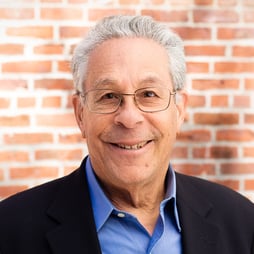
Don’s books have been published by major houses, translated into 15 languages, and sold in 29 countries. He founded Conversation Arts Media in 1991 and has led hundreds of communication workshops and coached writers and speakers. Don lives in Brooklyn with his wife, Eileen, and their cat, Ruby.
We talked with the author about what drew him to indie publishing, how his family history influenced his new novel, and what he hopes readers take away from it.
You’ve got an extensive history publishing titles with larger, more traditional publishers. What drew you to the independent publishing process for Vienna on Fire?
With Vienna on Fire, it’s my first fiction book that I've written. After years of research and writing this book I decided—I'm going to go the independent publishing route. I'd helped other people write books through self-publishing, so I have some experience on not just the writing side, but the editorial side. The indie publishing route has worked out for me, and I’m selling books every day. IngramSpark is helping me reach out to the library market and the other indie markets, and I’m grateful for that. So I give the independent publishing route a thumbs up, but with this caveat: you have to really want to be out there and want to do the work because that's what it takes.
The indie publishing route has worked out for me, and I’m selling books every day.
Tell us about the family history and discovery that ultimately led to this book. What sparked the idea to begin writing a novel?
That happened quite a number of years ago when my hair was a different color, and I was on vacation with my wife in Austria. We were standing in front of this apartment building in Vienna that was where my mother was raised as a kid. When I was younger and asked her what happened to her parents, she had always said, “Well, I guess they were killed in World War II.” Vienna was bombed a lot. So as a ten-year-old kid, you pretty much believe whatever your parents tell you. But fast forward 45 years, and I'm standing in front of this building, which in my mind shouldn't be there. And that's when the penny dropped that my mother really wasn't telling me the whole story. And that’s where the inspiration for the whole topic really began.
The book came about because I started researching and learned a lot that I didn't know about my family. I didn't know that her family was Jewish. I didn't know that her parents were Holocaust victims. I didn't know a lot. And when I had brought up some of these questions to my mother in the past, it was very touchy.
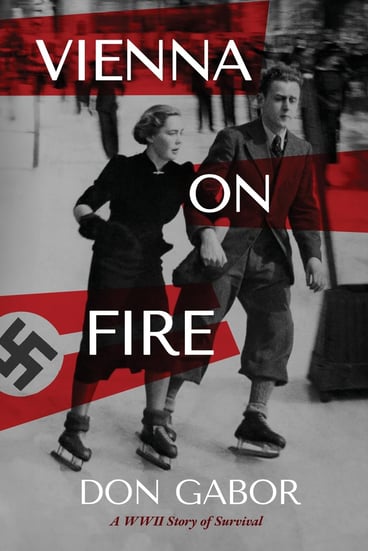
We did eventually find a box with photographs, one of which is the cover of the book with her ice skating in front of the town hall with a man, very close to the time that the Germans came into Austria—March 12th, 1938. But I couldn't write a history book, and a memoir was out of the question—my mother wasn’t interested in that. So being a storyteller to begin with, I thought this would make a really great novel. But I have to emphasize that this isn't just about my mother and her story of how she escaped from Nazi Vienna. It's not just her story. It's the story of a lot of people who experienced the same thing. Part of the research was reading other memoirs of people who went through similar situations and obituaries. The main character Greta Kolbe is really a conglomeration of a lot of people's stories into one character.
Speaking of your main character, reviewers have praised her resilience and strength in such a dark time. Why do you think this story and character in particular resonate so deeply with readers and reviewers?
When reading a novel, we look for somebody that we can identify with in some way. And it could be 100 years ago, or present day, or a different country, a different culture. I think people are looking at a character who is facing all kinds of obstacles. And in everybody's life, we're all facing some kind of obstacle, one or another. And sometimes they're from the outside, and sometimes they're of our own making. But I think what attracts a reader to a character is that they identify with them in some way. And my mother was always very tenacious, always very outspoken. You know, there was a saying in my family: “frequently wrong, but never in doubt.” Don't get discouraged. If it doesn't work this way, try something else. She inspired this female character that just doesn't give up.
Uncover the hidden past that sparked a gripping novel — dive into Vienna on Fire!
With a writing background of nonfiction titles on conversation and small talk, what new challenges or surprises came along with crafting a fictional novel for the first time?
There’s similarities and there's differences in all kinds of writing. You know, the similarities are you have to get words down on a page. And in most cases, the first time they get down there, it's a mess. The second time it's down there, it's still a mess, but you get your ideas. I mean, this is how I work anyway. In nonfiction, the sequence of things is very important, and the responsibility, in terms of the prescriptive side of it, I take very seriously. I get a lot of joy out of helping people, but I can't deny that with fiction, it’s just a lot more fun for me as a writer to create a story and then bring the pieces and mold that story into a larger story. That's how Vienna on Fire was created.
The tricky side to this for me personally was writing about my mother’s family and her parents. I won't go into all the gory details, but the upshot is that they did not survive. They were murdered along with the last several thousand Jews that were in Vienna. And so that was a pretty dark place. I didn't want the book to be about that, but it was always there. And so that made this book obviously very personal and difficult in that way. But the other side of it was how much I learned about how many people helped my mother and helped other Jews escape.

When you wrote this book, who was your target audience? What do you hope people take away from it in a larger sense?
What I hope will happen is that librarians will want to bring this book into their libraries for avid readers who are looking for books with strong female characters. Also, World War II history buffs like me because we're always looking for something to learn, and it's such a big topic. But also, I've been getting a lot of positive feedback from mature teens. I think they're interested in history, but not history books that are dry. They want the stories, and they're looking for the characters that they can relate to, particularly young people. I think they're looking for something that they may be able to emulate in some way, or it gives them some kind of hope that you can overcome things. Holocaust educators who are dedicated to furthering the understanding of something that happened so long ago. It was not necessarily a one-time event—it's happened since and it can happen again. Really, I want to reach as many people as possible, and my goal is to give a further understanding of what happened to not just one person, but a lot of people and not just one family, but a lot of families. You know, there's so much going on today that affects how we think of things. It's very easy to dismiss history, which I think is a big mistake. And so that's part of my goal is just to give people a little taste of something that happened a long time ago that they might benefit from in many ways.
If you could give future indie authors a piece of advice for their self-publishing journey, what would that be?
I was in the speaking business for 40 plus years, and I got some pretty good speaking advice there: If you want to speak, you've got to get out there and speak. And you may make a good speech, you may make a bad speech; a good workshop, bad workshop, whatever it is. But if you don't get out there, you're never going to know. And it's the same thing with writing. If you want to be a writer, you've got to write.
And don't depend on first drafts to get you anywhere except to the next—to the second draft and the second draft to the third draft and the third draft to the fourth draft. Don't give up. And get help. I've been doing this for a long time, and I had a lot of help along the way. IngramSpark is help for me, and it can be help for other indie publishers and authors who are looking for professionals who really understand how to reach the market. This is the hardest part, in my view. This is where a company like IngramSpark can really make a difference.