Emma Gannon is a Sunday Times-bestselling writer of nine fiction and nonfiction books, and a recent judge of the 2025 Women’s Prize. Her newest release, A Year of Nothing, has been widely praised for its inspirational, reflective take on recovering from burnout and rediscovering the joy of simple living. It was picked as part of The Observer Book Club and Fearne Cotton’s Happy Place Book Club.
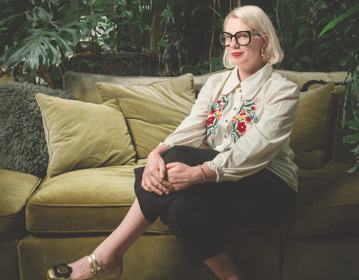
The author of Olive (long-listed for the Dublin Literary Award) and Table for One, a People Magazine "Book of the Week" and one of Apple’s "Best Books of 2025". The Multi-Hyphen Method was a Sunday Times Business Bestseller. Her writing has appeared in Oprah Daily, Vogue, Condé Nast Traveller, The Sunday Times, The Guardian, Elle, Vanity Fair, New York Magazine, and more. Her newsletter The Hyphen is one of the UK’s most popular newsletters on Substack, reaching 80k readers weekly. It was named by The Guardian as one of “15 of the best literary Substacks” and by The Times as “something of a pioneer” for her early podcasting and newsletter.
You’ve been traditionally published in the past but chose to go indie on this release. What made you go that route, and what makes indie publishing special to you?
I’d been publishing traditionally for around 10 years, and it felt like I needed a shift in the way I was approaching my creative life. I think it’s important to pause and check in with yourself every now and again, and the 10-year mark felt like a good point to properly do that! Also, my memoir A Year of Nothing was born out of a collaboration with The Pound Project, a small indie press, and then I chose to re-launch a more official version with Whitefox, with a new jacket and illustrations. It was an organic, special project, in that I was doing it for myself. The pressure was off. There was no big publisher or big advance. It was just a fun, free-spirited piece of writing that I wanted to get out there in a new way.
I loved publishing it on my own terms. It also felt safer, emotionally, to be in control of how it was created and marketed, as it is such a personal book.
What first inspired you to write this book, and did you find it difficult to write something so vulnerable and deeply reflective?
I didn’t expect to write a book about my burnout episode, and I certainly didn’t want to write a self-help book. I was too busy going through it privately; I really wasn’t thinking about my career or publishing during that time. But I am a journaller, and I had kept a diary of doodles and entries. Once I started getting better, and more myself again, I started finding the journal entries really interesting (and sad, moving, eye-opening), and I thought I could turn it into a short memoir. I think there was an overarching feeling of "maybe this could be useful to someone?" After all, books have always helped me through tough times.
Your book is structured around four seasons, each representing a phase in your journey to mindfulness, joy, simplicity, and more intentional living. How did you settle on this structure for your book?
My Year of Nothing felt so long and slow, like walking through sticky mud, and I had to really slow down. I started noticing the seasons more than ever, and how things were changing in my garden, and how I was changing as the year unfolded. It felt natural to write it month by month, because that’s how I was writing my journal at the time.
-jpg.jpeg?width=288&height=360&name=AYON_JC%20Post%20(1)-jpg.jpeg)
Get lost in Emma’s memoir on stepping away from burnout and rediscovering the beauty and joy of slowing down.
You have a foreword from Julia Cameron of The Artist’s Way. Tell us about your relationship to her and her work, and how you knew she was the right voice to introduce your book.
Oh, Julia Cameron is my North Star! I love her work so much. Along with millions of other people, she has so generously given people the tools to get through life in a simpler way. Hosting my podcast, Ctrl Alt Delete, for six years enabled me to connect with so many amazing writers and artists. I interviewed Julia three times for the podcast, and they are some of my favourite interviews. Because of the time difference, I’d interview her at my desk, with it dark outside, at around 8pm, and just felt so inspired by her presence, even if it was on Zoom. We ended up emailing, becoming long-distance friends. I wrote the foreword for the UK re-release of her memoir Floor Sample. Then I was honoured when she so kindly agreed to write the foreword for A Year of Nothing. She’s a very special person.
A Year of Nothing has received huge praise from critics and readers. Has anything surprised you about the ways in which this book has resonated with your audience?
It’s been wonderful hearing the responses to the book, and to have such support from the mainstream media, like The Observer and Bloomberg, for a self-published book! But I’ve also had to shelter myself from reading too many of the responses—as it’s such a personal book, it felt too weird to imagine my burnout being "rated" or "reviewed". People have been very kind about it. Some readers have acknowledged that there is an aspect of privilege to my story, and not in a negative way. It’s true that I was able to take time out because of my choice not to have kids, and my financial situation, that others might not have the same opportunity. This makes me lucky, and I understand why people may have had certain personal reactions to the book.
Why do you think we find it so hard to take time to rest, recover, and reconnect? What does our culture tend to get wrong about “self-care” in your opinion?
One of the most commonly asked questions I’ve been getting, post-book release, is this: "How do I avoid, or prevent, burnout? How can I not go through what you’ve been through?‘" But I don’t actually think that’s what A Year of Nothing is about. The book is saying: it’s OK if you do burnout. It shouldn’t be embarrassing or scary. It’s actually pretty inevitable in this crazy world we live in. The world won’t end if you need to take a break. It can even be a beneficial thing. Falling apart does not make you weak, and asking for help is actually a sign of strength. The first big burnout can be an important thing to go through because then you learn tangible ways to move forward, rather than frantically (ironically) always trying to prevent it happening.
As a mentor to others, what advice can you offer writers who want to build a sustainable creative life?
A sustainable creative life needs input, as well as output. Make sure you are finding joy, curiosity, and cultural enjoyment wherever you can. Put a weekly or monthly "artist date" in your diary. Read widely, be interested in other people, support your peers, be in community. The more good quality stuff you’ve got going into your system, the better your work and life will be.
What’s a misconception about creativity or the writing life that you’re tired of hearing?
That it’s too hard! Yes, of course, it’s hard to write a book, but not as hard as digging a ditch or working in a hospital or working in a busy restaurant. It is a wonderful, beautiful way to spend one’s time, and I find people who complain endlessly about their writing life quite off-putting.
You’ve written across a massive range of work from nonfiction to novels. Do you see a through-line in all of your work?
Yes, I think the through-line is "living a life on your own terms." From my novels about solitude, to being child-free, to working for yourself, to living a creative life.
What are you most excited about these days?
Enjoying the ordinary moments of life more! In my twenties and early thirties I wanted a big, bold, exciting life. I was so scared of being "boring". Now, I just want to enjoy my days in quite a normal way.